Updates on the Central Stone at Giant’s Castle Maze
Since our initial investigations into the Giant’s Castle Maze central white stone - discussed in a previous blog post here - this enigmatic rock has grown even more intriguing and has throw up many more questions than it has answered. We had initially presumed that the stone was quartz, which was not an unreasonable assumption given that quartz is the predominant white stone found on Scilly, as the islands are made almost entirely from granite.
A 3D scan of the GIant’s Castle Maze central stone, created by archeologist and technologist Tom Goskar, during his visit to Scilly to survey Giant’s Castle Maze for our project.
However, when we were visited by Dr Tehmina Goskar, who is a museum curator and material culture and collections specialist at The Museum of Cornish Life with a keen interest in minerals, mineralogy and gem stones, she realised straight away that this stone is not actually quartz at all. Tehmina informed up that it is in fact a type of hard, fine-grained rock - most likely chert or possibly flint. There are some flint and chert deposits on Scilly, which were deposited on the islands during the last Ice Age, which made the islands an appealing destination for prehistoric visitors:
“During the third Ice Age, some 250,000 years ago, the moving glaciers reached the Isles of Scilly and to some extent helped to re-shape the islands into their present contours. During the advance of the glacier, rock debris was collected as it passed over the land masses and when finally the ice melted the debris was deposited by small streams formed at the edge of the retreating glacier. Amongst these "glacial erratics" as the rock debris is termed, that were deposited in Scilly were large quantities of flint and greensand chert pebbles. Large quantities of these can be found on Chapel Down, St Martin's. It was undoubtedly these pebbles which helped to attract the first settlers to the islands in about 2000 B.C. Larger flints would have been in short supply in the west of Britain due to the lack of chalk deposits, and to these settlers, who fashioned their everyday implements from stone, it was convenient to have a suitable supply of raw material close at hand.”
~ Luke Over in Visitor’s Guide to Archaeology in Scilly, 1974
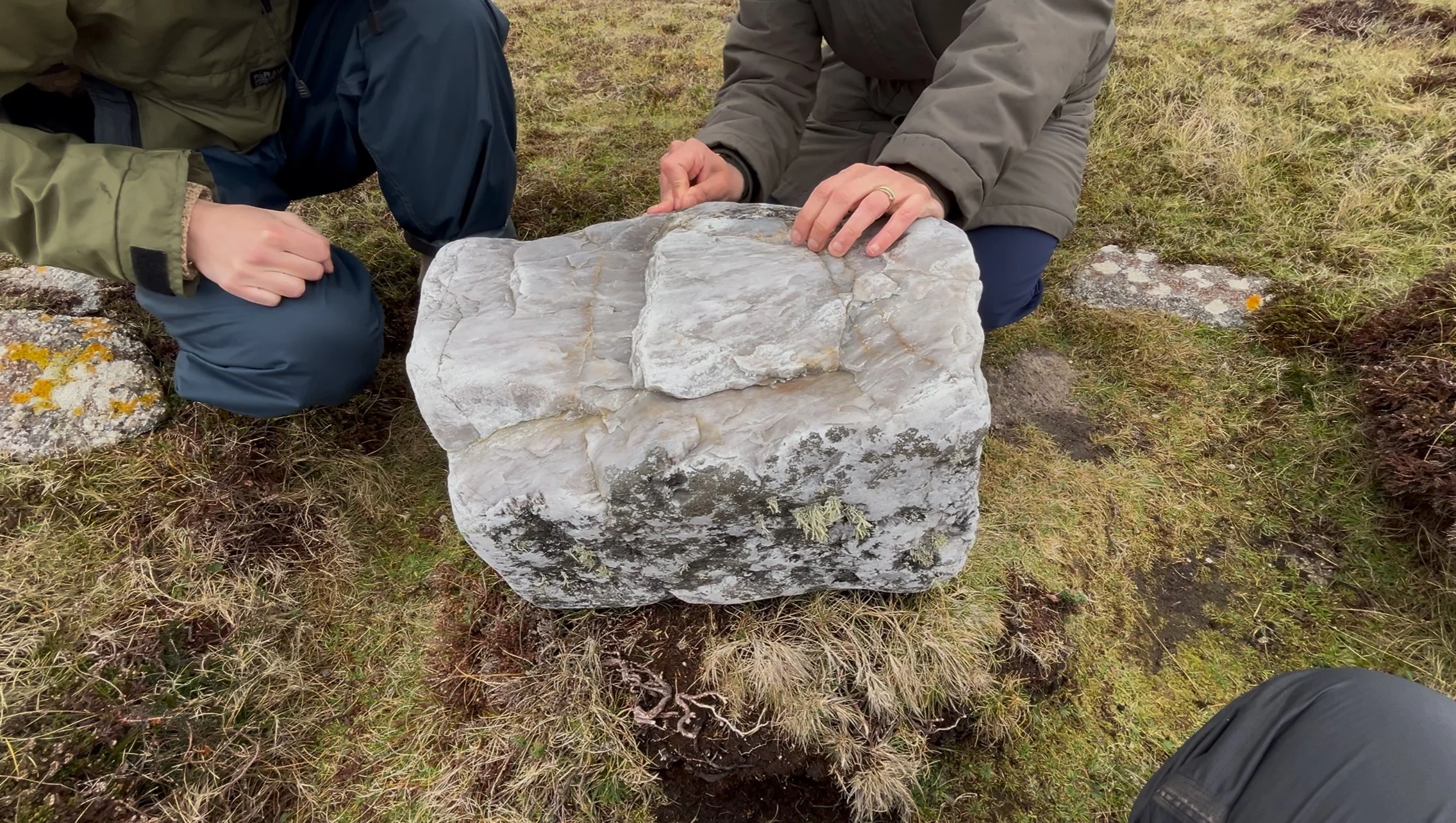
Dr Tehmina Goskar investigates the Giant’s Castle central stone...
Chert or flint stones of this size are unusual in Scilly though, and Chapel Down on St Martin’s where these glacial deposits were dropped, is about six kilometres away, four of which are over open sea. How did this large, incongruous boulder get to be out at Giant’s Castle to find its way into the centre of the labyrinth? We wondered whether it could have had any significance for the Iron Age people who built the nearby cliff castle? Or whether it was brought to the site for some unknown purpose at a later date.
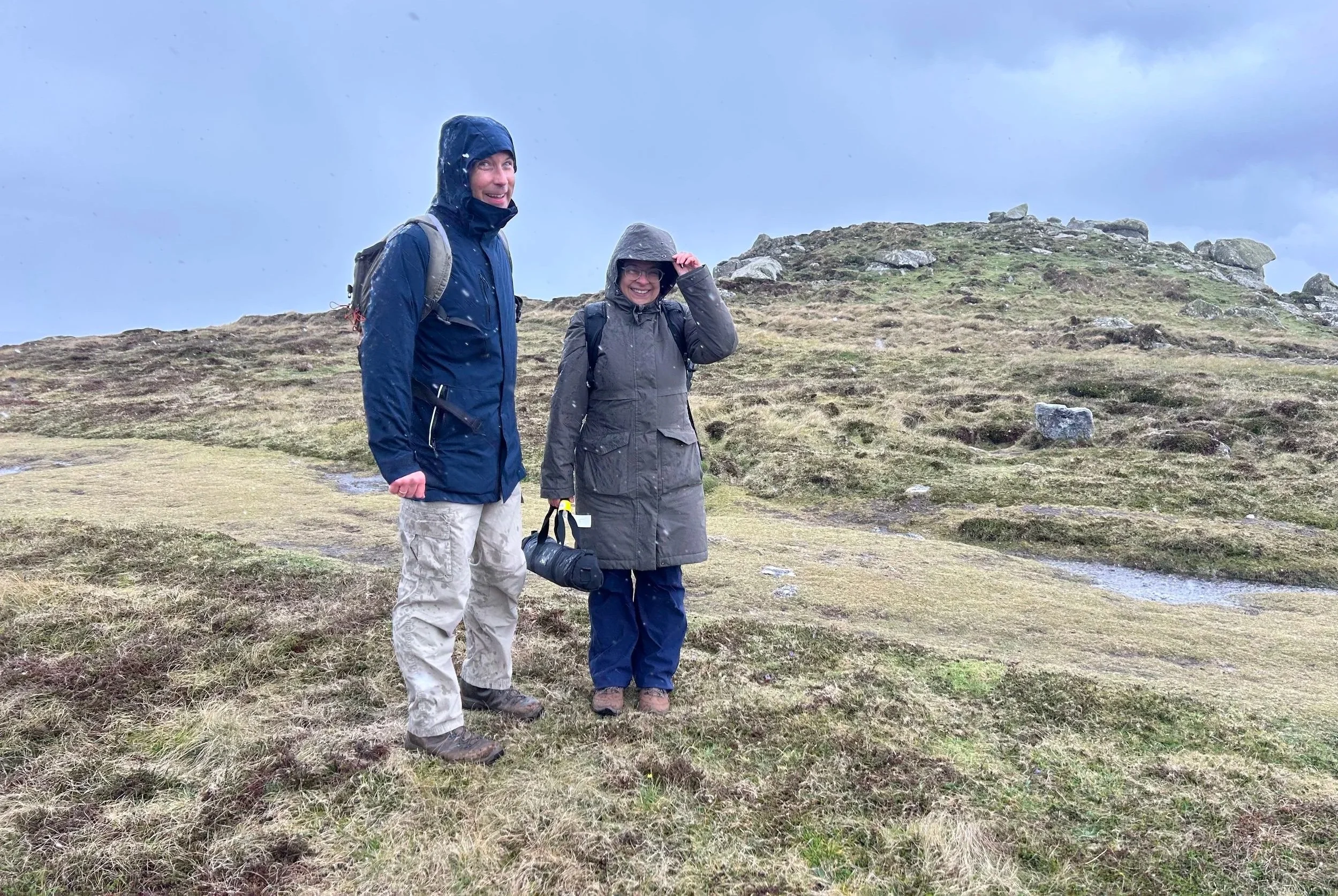
Tehmina and Tom Goskar braving the terrible weather to visit the Giant’s Castle site…
It is interesting though that a loose boulder of this size wasn’t incorporated into the WWI bunker adjacent to the maze site, which is built from dry stone wall. I would have thought that, if it was already in close proximity to the site in WWI, a block of this size and shape would have been a perfect candidate for easily accessible building stone. This suggests to me that the stone must have arrived on Salakee Down after the WWI bunker was built, otherwise surely it would have been used in that? We discussed before that the rounded edges of the stone suggest it had been in the sea - could it have been pulled out of the sea sometime after WWI? And if so, why?
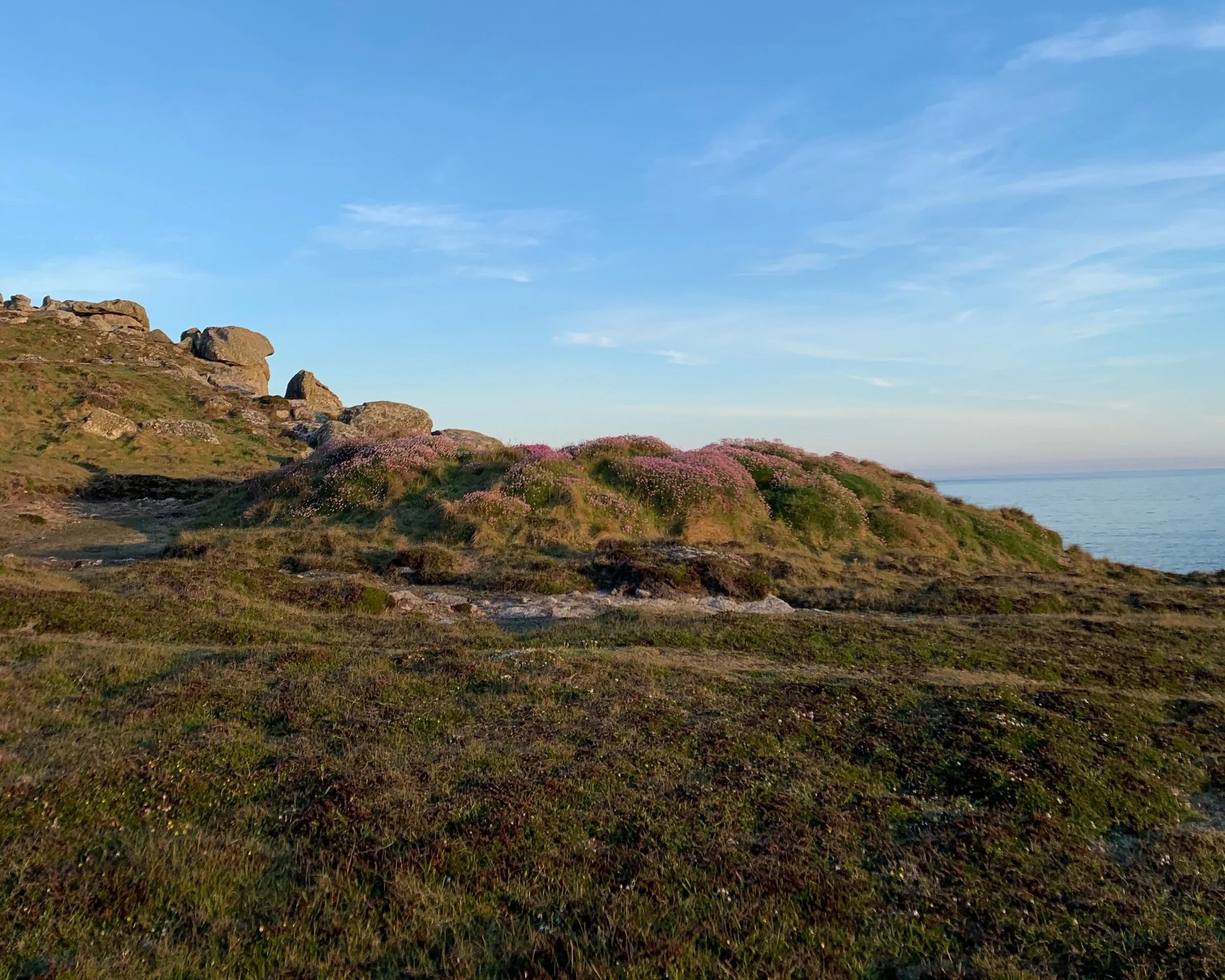
WWI bunker - I think possibly it was a target, not a bunker - but its a mound built around four drystone walls…
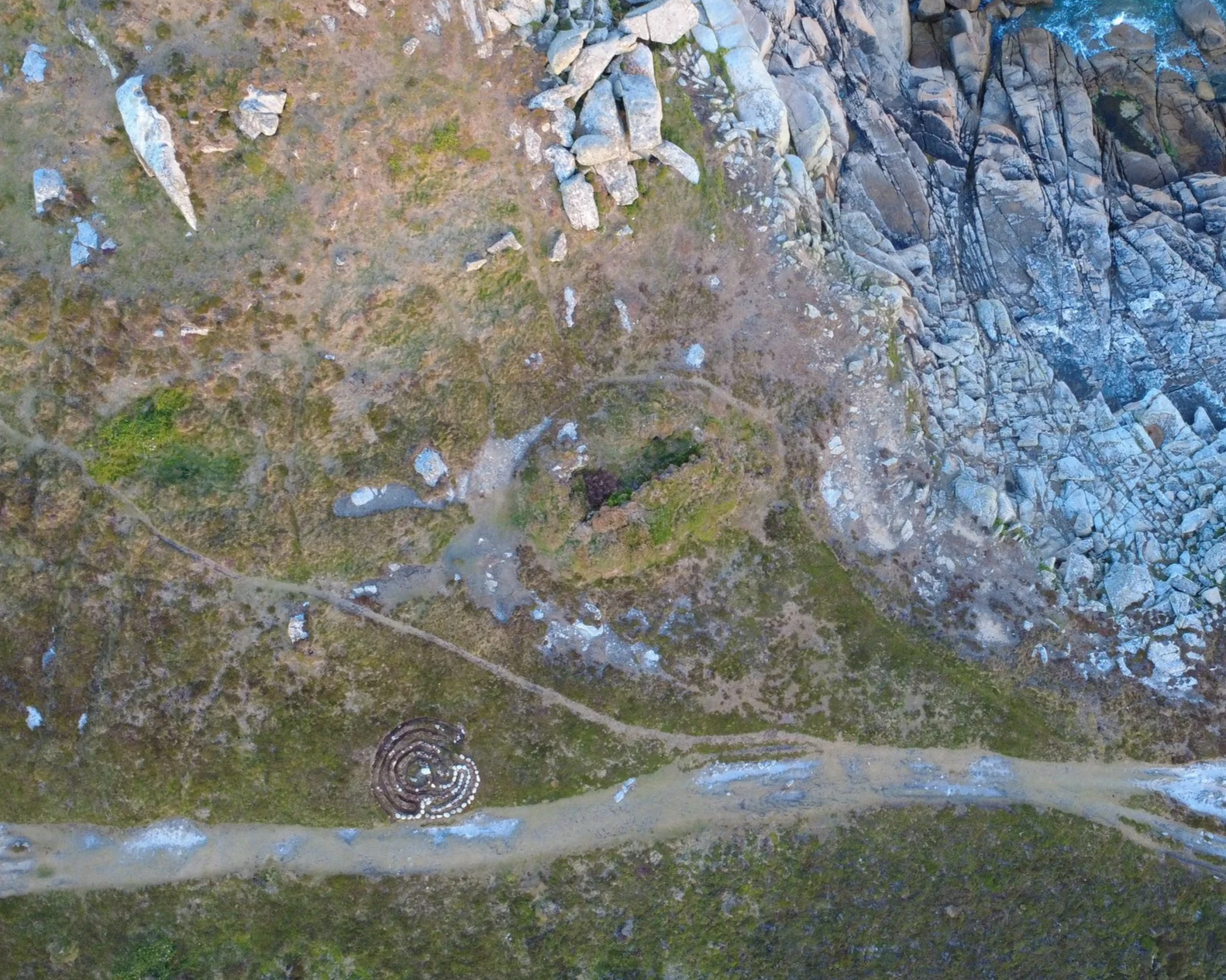
WWI bunker from above, centre of the image, with the rectangular interior (defined by dry stone walls) visible…
Then, during the discussion at the end of our online event to present the labyrinth research so far, there was further conversation about what the central stone could be made from. Labyrinth expert Jeff Saward followed up with us afterwards to say:
“The discussion of the identity of the central white stone was certainly interesting, and on reflection I think that white chert is probably the most likely identity for that rock, but a couple of close up photos of its surface would be helpful to clinch the identity. I will be meeting with several geologists next week who are experts in the field of glacial erratic rocks, so their opinions might help clinch the identity. Flint, chert and sarcen are essentially all the same material, just with differing formation processes and crystalline structure, but the question of how that block of stone made it to Giant's Castle remains a mystery. Smaller chert cobbles, arriving during the Ice Age, are certainly found elsewhere on the islands, so maybe this very large example was carried to the location at some stage in the history of the site and then chosen for the centre stone by the two children who built the labyrinth.”
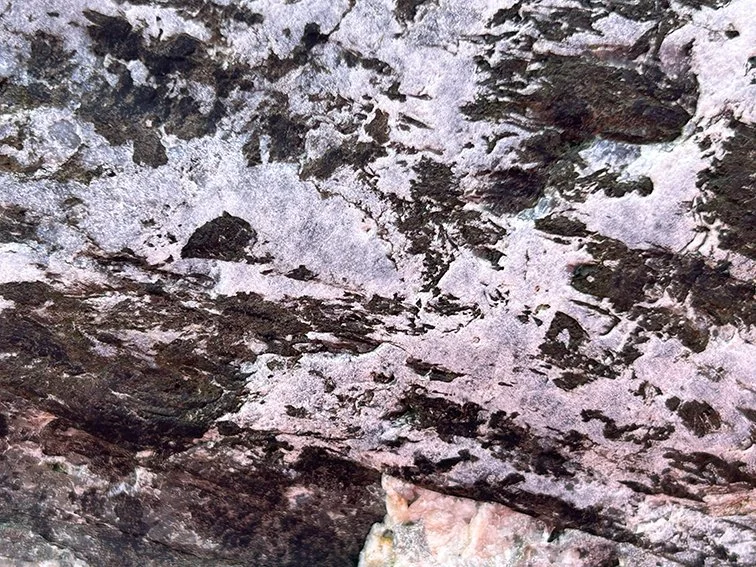
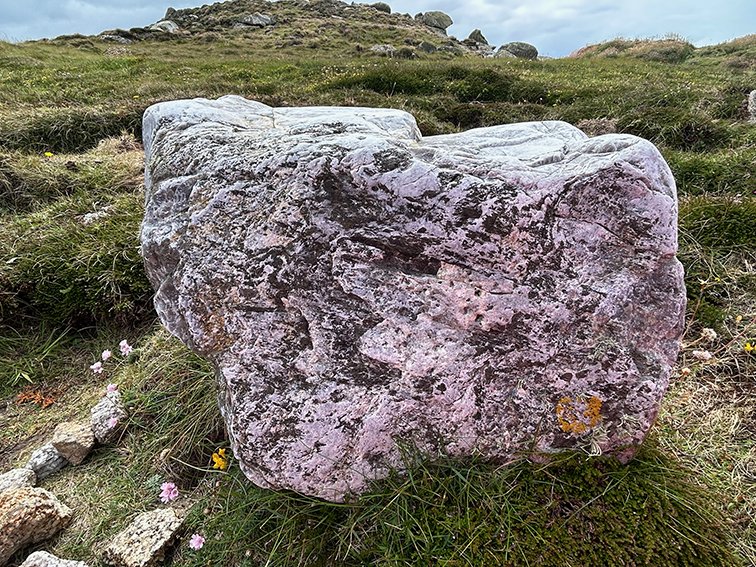
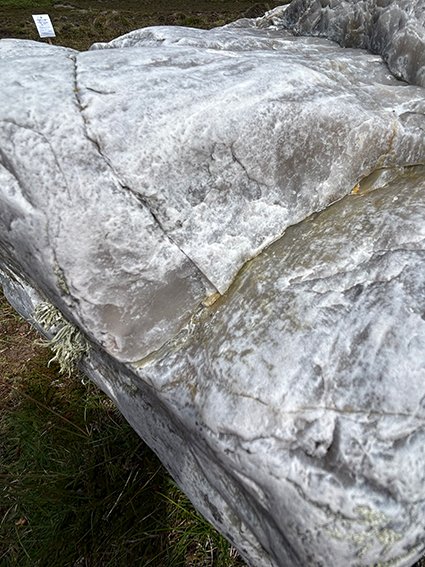
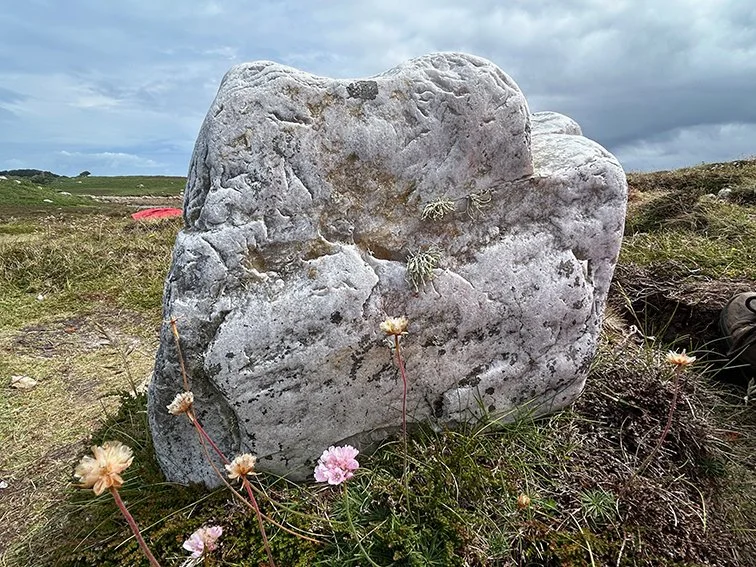
I followed up by sending some close up images of the stone, and Jeff’s reply was:
“I showed your excellent photos to my colleague, a retired scientist from the Geological Museum in London, at our meeting this morning and he immediately recognised the type of stone and the likely source! It's Ordovician quartzite, formed around 450 million year ago, probably from Carne, near Roseland in Southern Cornwall. This was quarried at Carne in WW2 to grind up for high-purity silica for electronics components, and large blocks of it can also be found where it outcrops on the beach there. The rather water-worn look of the Giant's Castle boulder might suggest that the rock was originally from the beach at Carne, collected at some stage and transported to the Isles of Scilly for construction works, whether in connection with the lookout post there, or for another purpose, and then somehow lugged to the top of the cliffs will remain a mystery I suspect. Hope that answers the question of what it is, if not how it got there!”
I then fell into a hole researching Ordovician quartzite and its uses since pre-history. If you would like to do the same, follow the wikipedia entry here.
As Jeff pointed out, it is great to know the material of the central stone, but how and why it got to be on Salakee Down, if the nearest source is 100 kilometres away on the Roseland in Cornwall, remains a total mystery!