The Trojan Game: Troy & Labyrinths
Because so much of our project has centred around Troy Town Maze, one question we get asked a lot is about its name. Why does this labyrinth on St Agnes - like so many other labyrinths across the world - have a connection with the city of Troy? There are a lot of theories about why labyrinths are connected with Troy, and it isn’t a straightforward answer. I was ready to go into a deep dive, pulling out all the references we have found linking labyrinths with the dance that Theseus reportedly danced after escaping from Crete and slaying the Minotaur; to the labyrinthine Trojan game performed by Greek youths on horseback. But then I found a beautifully written, well researched blog post by Elisabeth Storrs on The History Girls Blog that succinctly pulls all these parts together, so instead of muddling thorough it all myself I am just going to quote the relevant parts of Elisabeth’s writing here instead. So in Elisabeth’s words:
“In the ancient world, the feat of escaping a labyrinth was associated with a triumph of life over death. In some cases, navigating one was seen as a form of initiation where a boy was required to enter as a child and emerge as a man after surviving danger. One such initiation ritual was known as ‘The City of Troy’ in Rome and Etruria.
The City of Troy was a reference to the labyrinth of Crete. Yet what was the connection between the legendary cities of Troy and Knossos? An explanation comes from both archaeological evidence and the poetry of the Roman poet, Vergil.
In his great epic, The Aeneid, the Roman poet Vergil tells of the wanderings of Aeneas, the son of Anchises and Venus, following the fall of Troy. After fighting to defend the besieged city, Aeneas escaped carrying his father on his shoulders while leading his young son Ascanius (who later came to be called Iulus) to safety. According to Roman tradition, during the funeral games for his grandfather, Ascanius took part in a processional parade or dance called the Game of Troy (Lusus Trojae) while mounted on a horse given to him by the Carthaginian queen Dido. The young prince and his companions performed a complex weaving pattern by riding between and around each other as though threading their way through a labyrinth. Vergil drew a comparison between the tortuous convolutions of the rite to the twisting pathways within the Minotaur’s den at Knossos. He also referred to the manoeuvres of the game as mimicking the ‘Crane Dance’ performed by the youths Theseus saved from the Minotaur. From Vergil’s description it is clear that completing the game involved great skill to avoid injury or death.
The Translation of Virgil I liked best, by John Dryden…
And, as the Cretan labyrinth of old,
With wand’ring ways and many a winding fold,
Involv’d the weary feet, without redress,
In a round error, which denied recess;
So fought the Trojan boys in warlike play,
Turn’d and return’d, and still a diff’rent way.
Thus dolphins in the deep each other chase
In circles, when they swim around the wat’ry race.
This game, these carousels, Ascanius taught;
And, building Alba, to the Latins brought;
Shew’d what he learn’d: the Latin sires impart
To their succeeding sons the graceful art;
From these imperial Rome receiv’d the game,
Which Troy, the youths the Trojan troop, they name.
~ From The Aeneid by Virgil, translated by John Dryden.
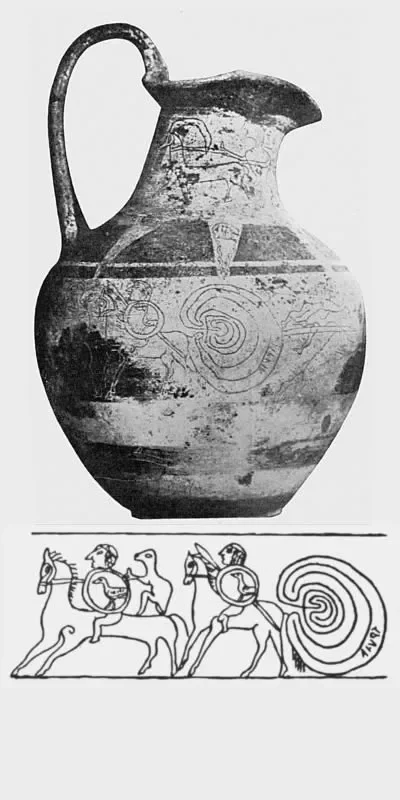
The Tragliatella Vase, c. 630-600 BCE, an Etrusco-Corinthian jug found near Caere (modern Cerveteri) in Italy…
The Translation of Virgil that Elisabeth Storrs uses in her post…
The column split apart
As files in the three squadrons all in line
Turned away, cantering left and right; recalled
They wheeled and dipped their lances for a charge.
They entered then on parades and counter-parades,
The two detachments, matched in the arena,
Winding in and out of one another,
And whipped into sham cavalry skirmishes
By baring backs in flight, then whirling round
With leveled points, then patching up a truce
And riding side by side. So intricate
In ancient times on mountainous Crete they say
The Labyrinth, between walls in the dark,
Ran criss-cross a bewildering thousand ways
Devised by guile, a maze insoluable,
Breaking down every clue to the way out.
So intricate the drill of Trojan boys
Who wove the patterns of their prancing horses,
Figured, in sport, retreats and skirmishes
~ From The Aeneid by Virgil, translated by Robert Fitzgerald
Elisabeth continues: “Vergil conjured the image of the Lusus Trojae when writing in the 1st century CE, but there is archaeological evidence of its existence dating from the late C7th BCE. The Tragliatella Vase discovered near the Etruscan city of Caere (modern Cerveteri) depicts two horsemen emerging from a spiral marked with the word ‘Truia’. A line of marching warriors is also displayed on the wine jug which seems to suggest that the vase portrays a military ceremony similar to the one of legend. As the Romans were heavily influenced by the Etruscans, it is plausible that the equestrian ceremony that was later referred to by Vergil was in fact an Etruscan tradition.
The Game of Troy was ‘revived’ by Julius Caesar who claimed to be a descendant of Iulus (Ascanius) and was performed by the young sons of high ranking families. It was not associated with any particular religious festival and was conducted at funeral games and in military triumphs. Suetonius and Tacitus also wrote of the Lusus Trojae which appears to have become more of a military review by the time of Nero.
With my love of all things Etruscan, I found the etchings on the humble Tragliatella Vase intriguing enough to inspire me to include an episode in my book The Golden Dice: A Tale of Ancient Rome involving the Troy Game. Yet what strikes me most about the Lusus Trojae is how legend, poetry and history are intertwined and held fast by a strong thread from two epic stories that inspired three great civilisations: Etruria, Greece and Rome.”
Thanks to Elisabeth Storrs for pulling all that together so beautifully. You can read more of her work via her website www.elisabethstorrs.com or on the fantastic History Girls Blog.