Rocky Valley Carved Labyrinths and the tradition of West Country Troy Stones
“Run your finger over the labyrinth and enter a forest at night-time, a world of spirits.”
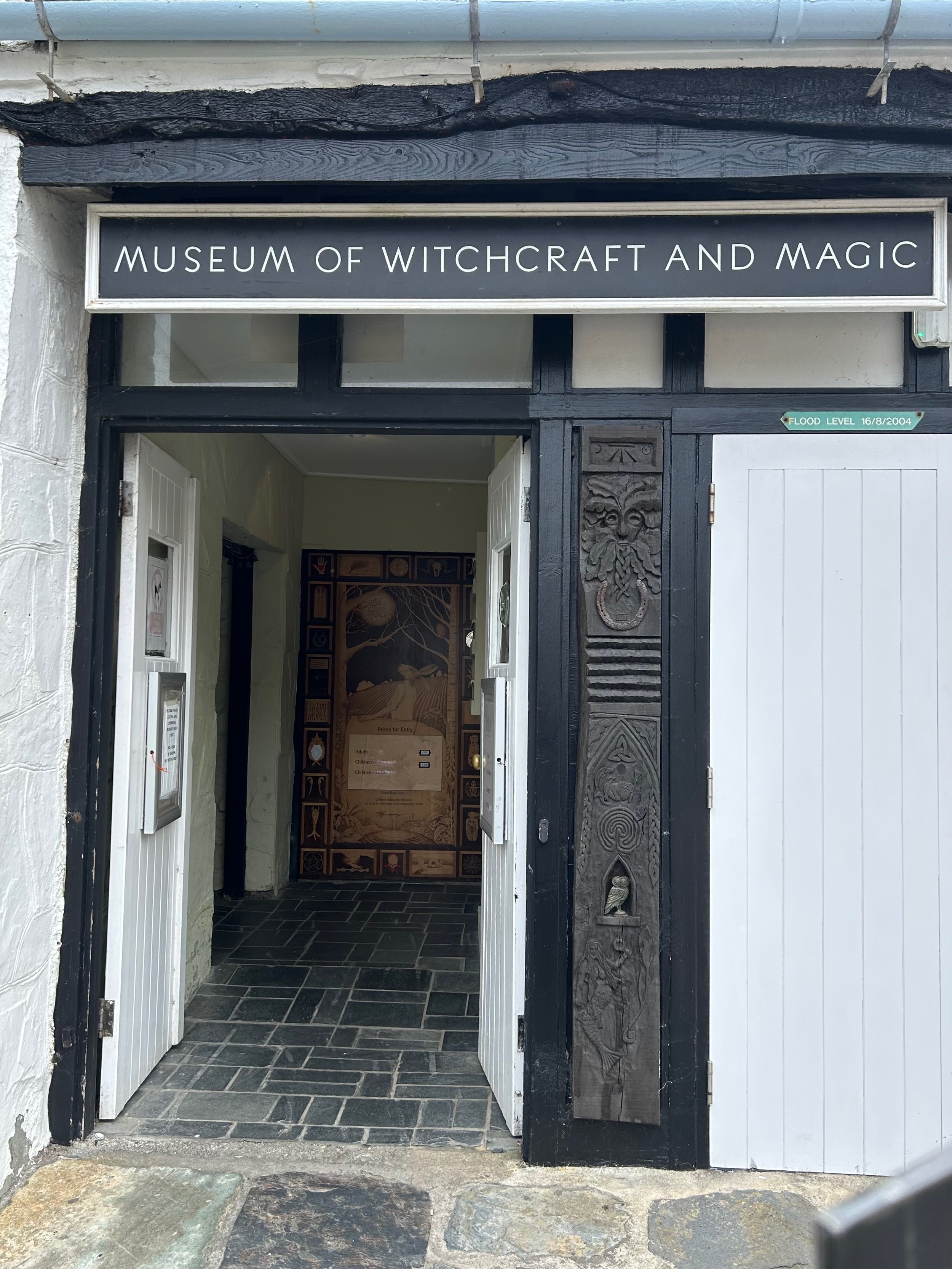
Entrance to the Museum of Witchcraft and Magic…
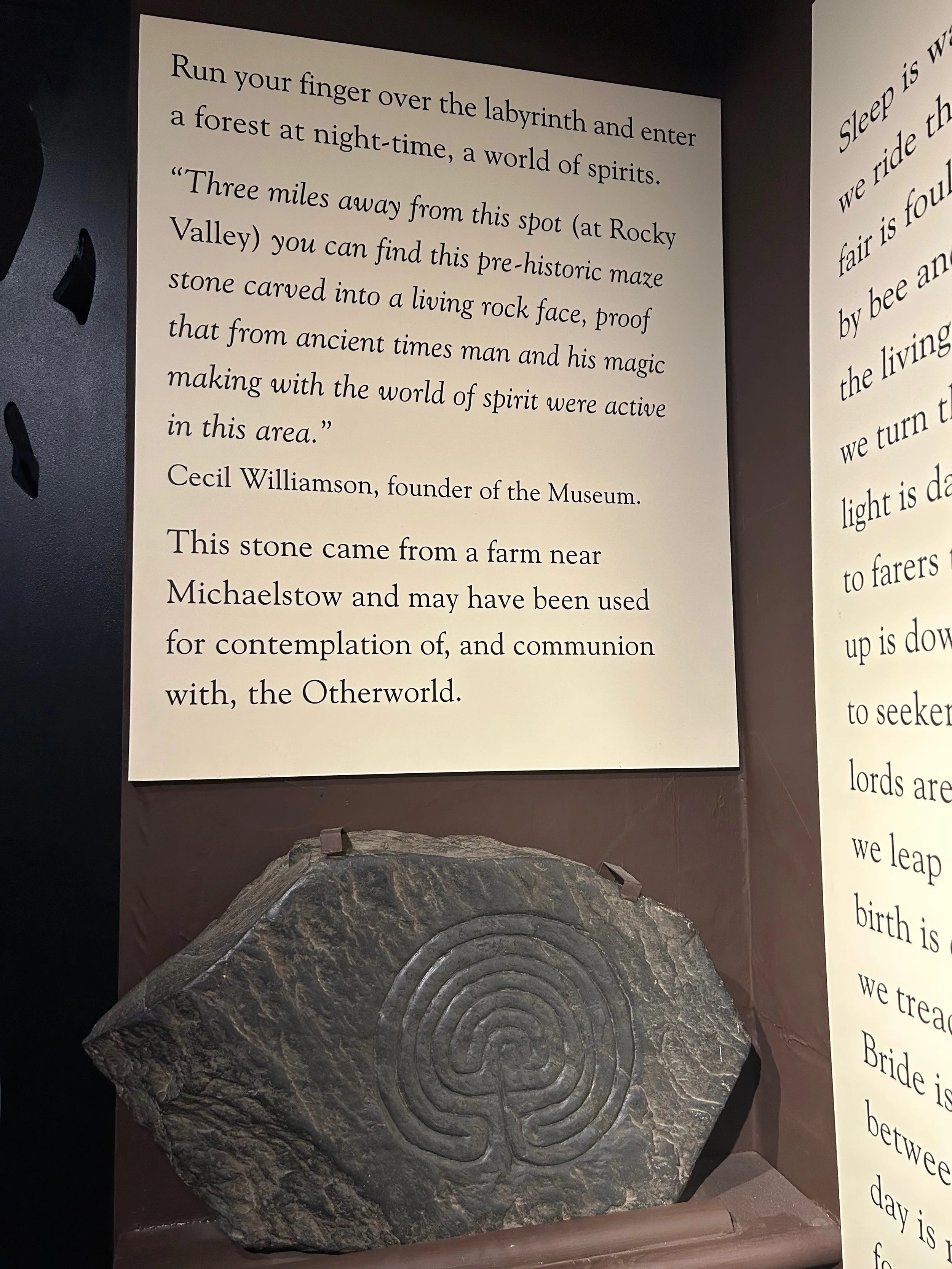
The incredible Troy Stone on display in the museum…
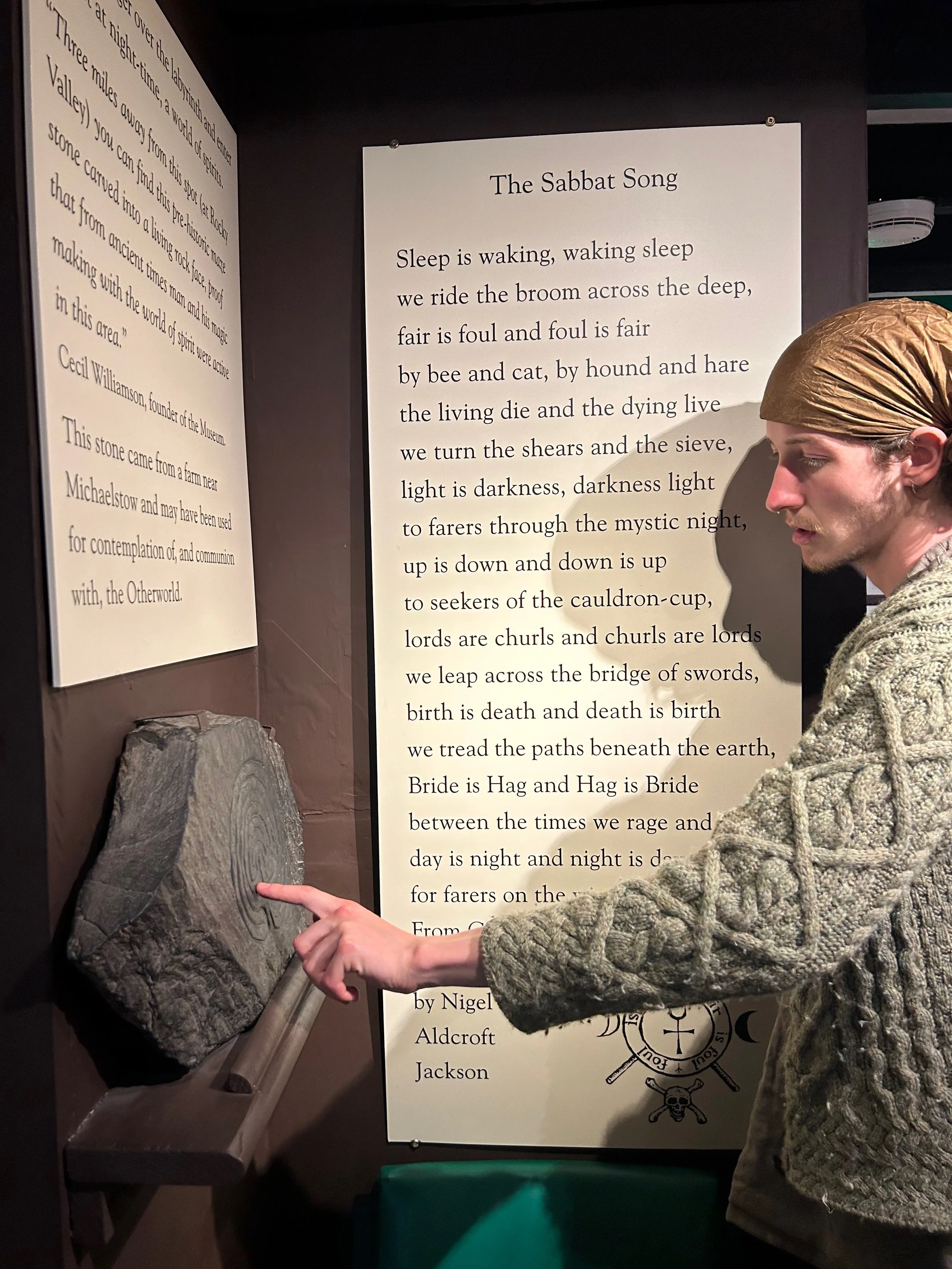
Layan walking the Troy Stone labyrinth with his finger…
Back in August 2023, we went on an (extremely rainy) road trip around Cornwall, camping in fields and exploring ancient sites. This trip included a visit to the Museum of Witchcraft and Magic in Boscastle, somewhere I have been lots of time and love dearly, but Layan had never visited before. In the museum we saw an incredible example of a Troy Stone, a labyrinth carved into a piece of rock, and used by witches as a meditative aid to enter altered states. Looking back now, this trip definitely helped to sow the seeds for the labyrinth project (something Layan wrote about in an earlier blog post), as we noted the similarity of names between these stones and St Agnes’ Troy Town Maze. The names were just one of many connections we would find between these labyrinths.
Accompanying the Troy Stone was a quote from the museum’s founder, Cecil Williamson, who described that “three miles away from this spot (at Rocky Valley) you can find this pre-historic maze sone carved into a living rock face, proof that from ancient times man and his magic making with the world of spirit were alive in this area.” Despite the rain, we thought we had to go and try and find these labyrinth carvings while we were in North Cornwall.
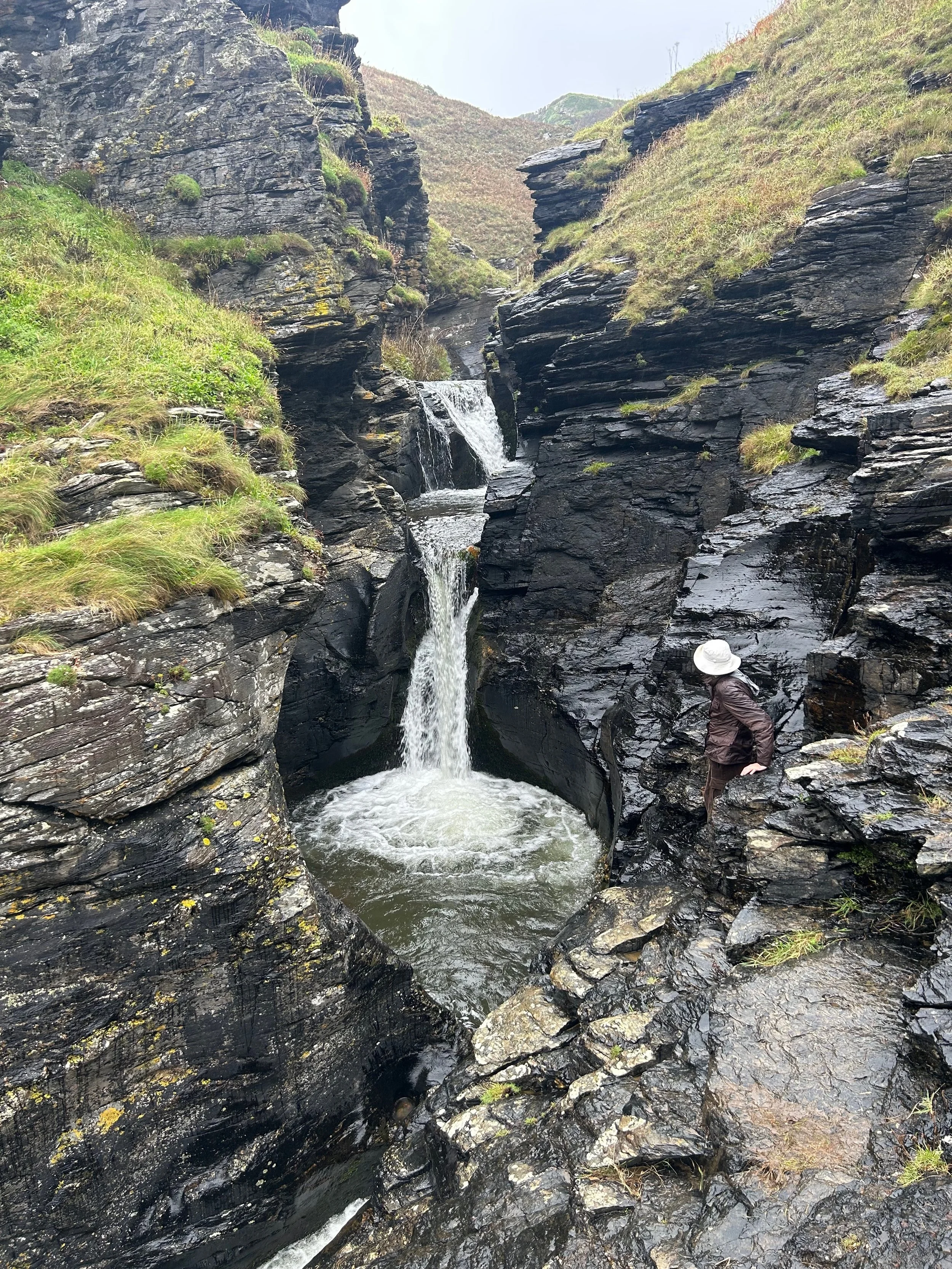
Looking for the labyrinths in Rocky Valley: the view up the river…
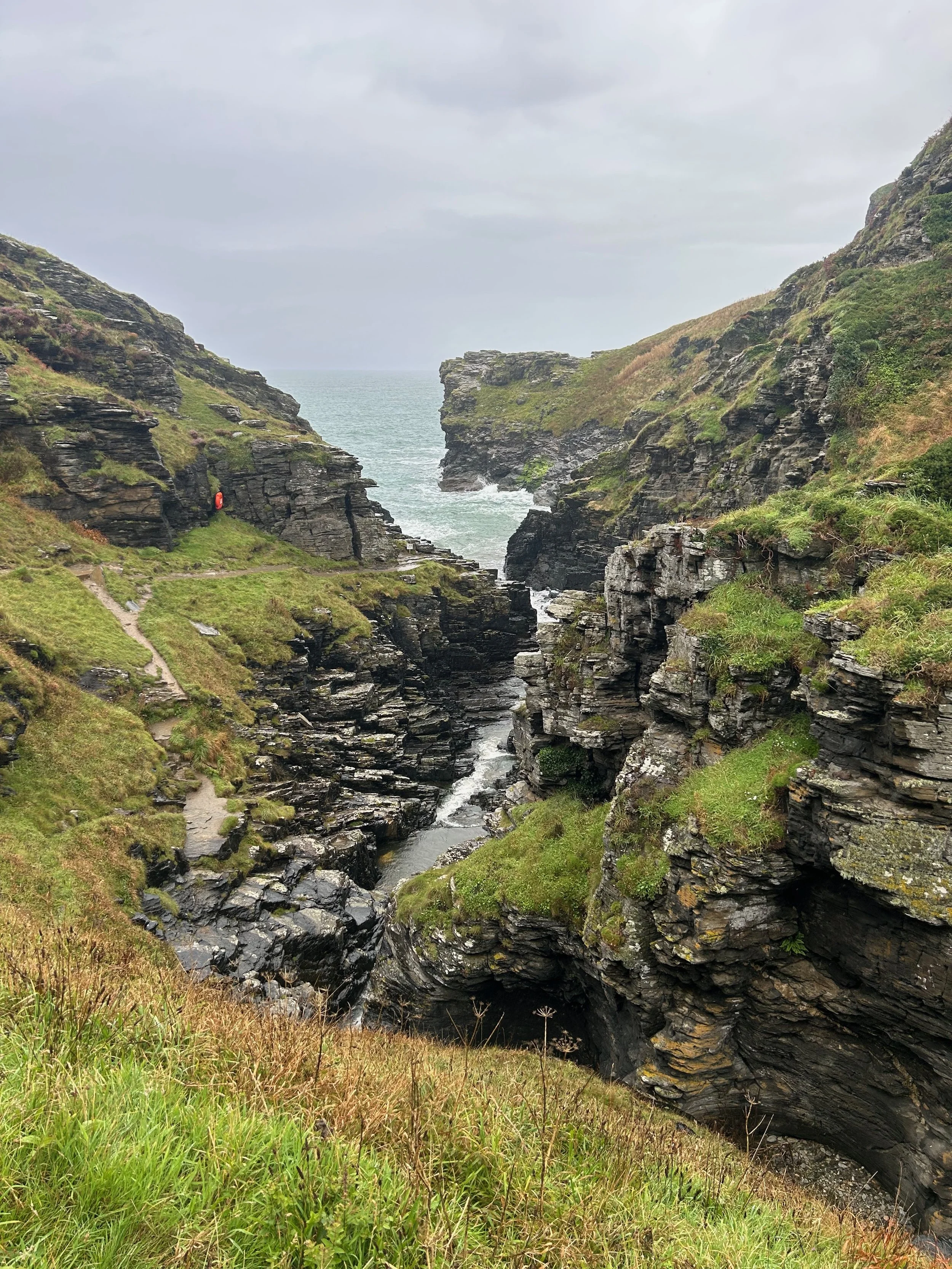
Looking for the labyrinths in Rocky Valley: the view back down to the sea…
We didn’t have any more information to go off than the quote from the Witchcraft Museum, and there was no phone signal with which to access any useful blog posts to explain how to find the carvings, so it took us quite a long time to locate them, finally discovering them about half way up the valley behind some ruined mill buildings. But when we did find them they were completely amazing: two carved petroglyphs, so similar to the Troy Stone at the museum in size and design that I feel one must have inspired the other, carved at different heights into the rock face of the valley.
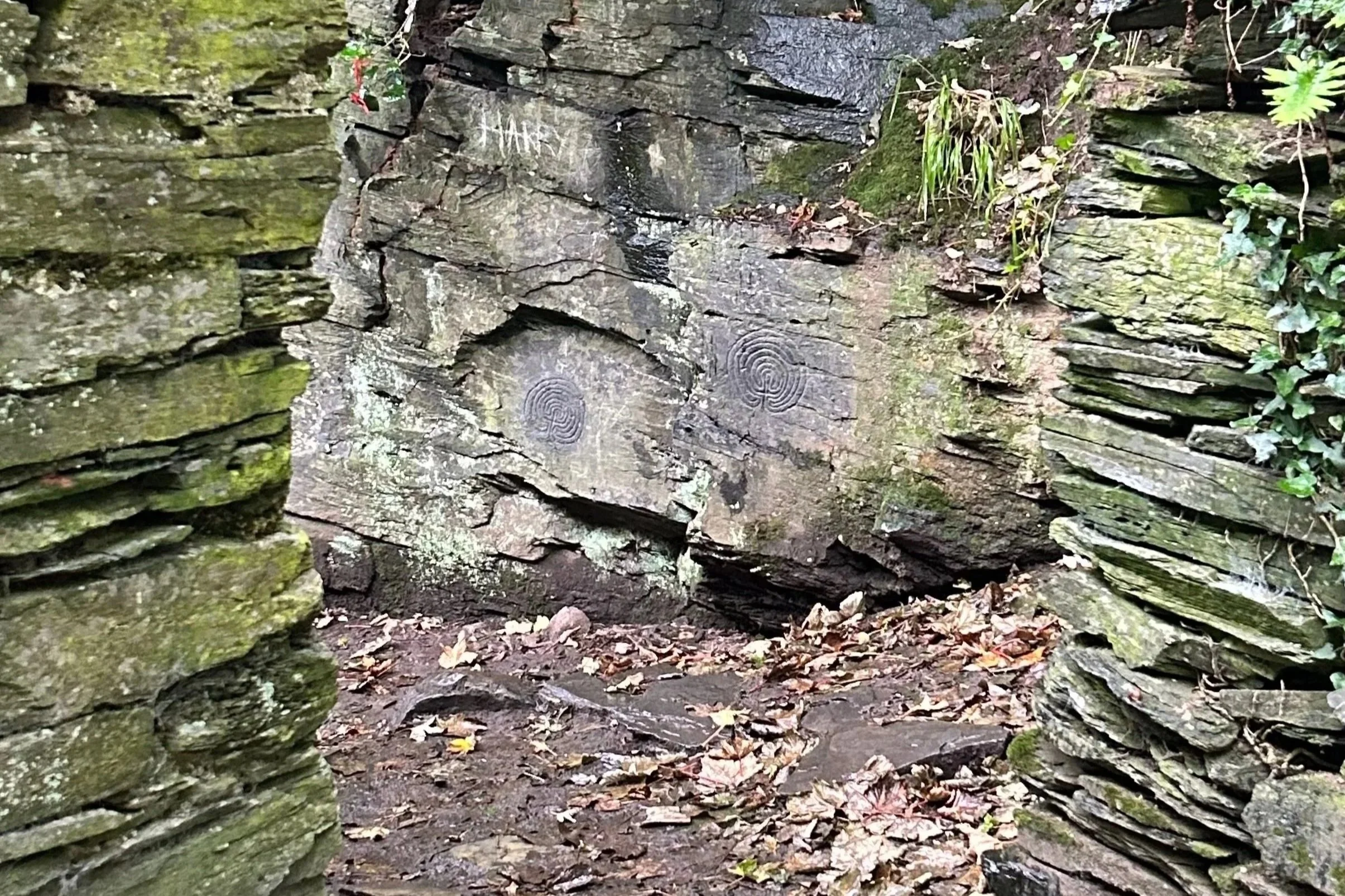
First sight of the Rocky Valley labyrinth carvings between the old mill buildings…
It is notoriously difficult to date petroglyphs, so finding any dates for the carvings is pretty near impossible, but it is largely accepted that the nearby plaque dating these carvings to the early Bronze Age is erroneous. It is more likely that the carvings date to the same period as the mill, built in the 18th Century. One archeologist told me that the cliff they are carved on was created as a result of blasting the stone away to make space to built the mill, so they cannot pre-date the mill building, but many still believe in the earlier origin story. Here is another parallel with Troy Town Maze on St Agnes. Both sites are attributed to the 18th century (Troy Town Maze was reportedly built by the son of a lighthouse keeper, Amor Clarke, in 1729) but have rumours of being much older; both are seven-circuit, unicursal, classical labyrinth patterns; both are in the South West of England; both are entirely unique in the UK. I have since heard a theory that the Rocky Valley labyrinths were carved by an 18th Century witchcraft cult, who used them in rituals similar to the Troy Stones in the museum, which is a fun idea - I like to think that perhaps Amor Clarke, the Troy Town Maze maker, might have been a secret member of this cult as well, but that it just a fantasy.
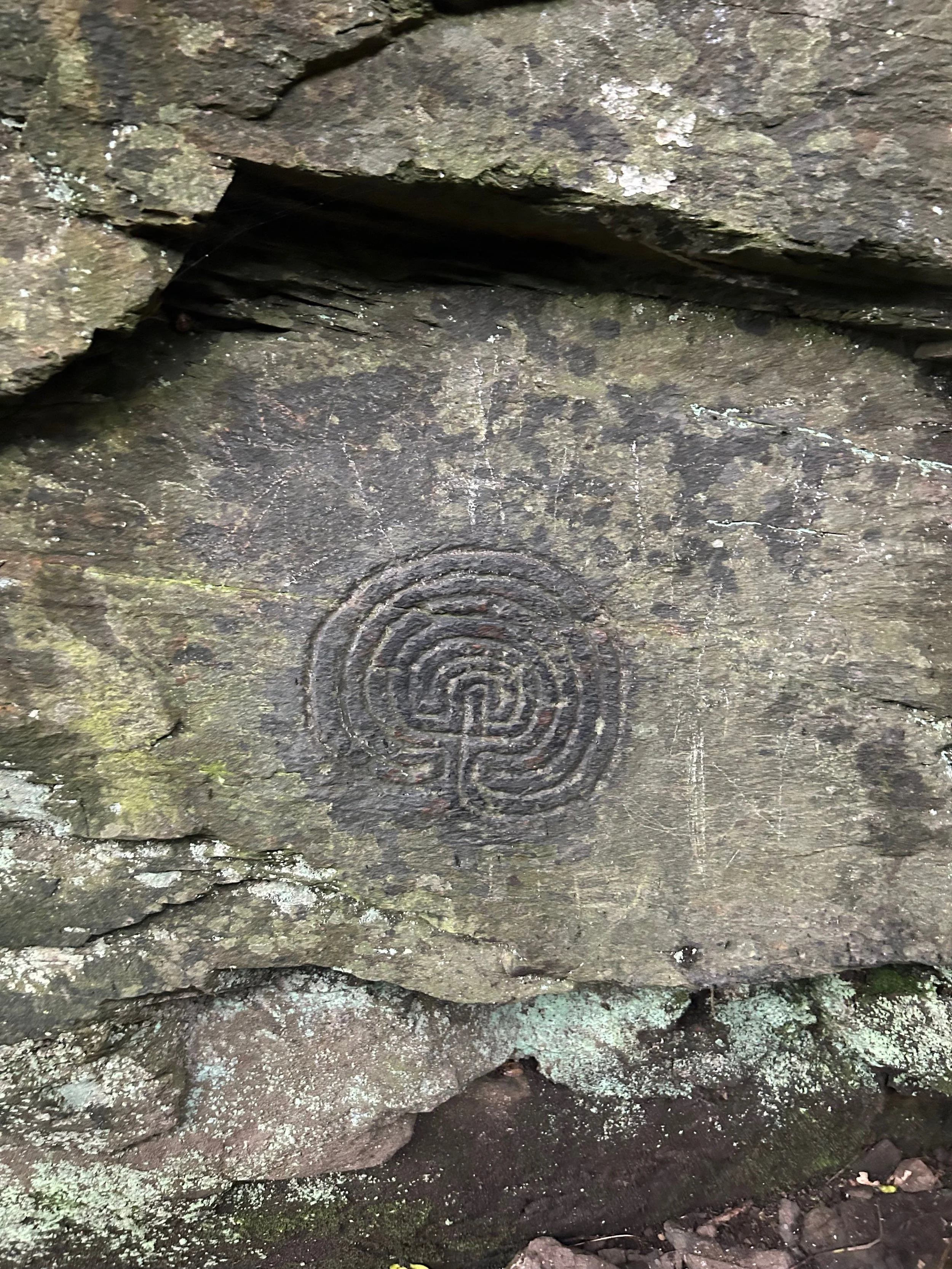
One of the labyrinth carvings at Rocky valley…
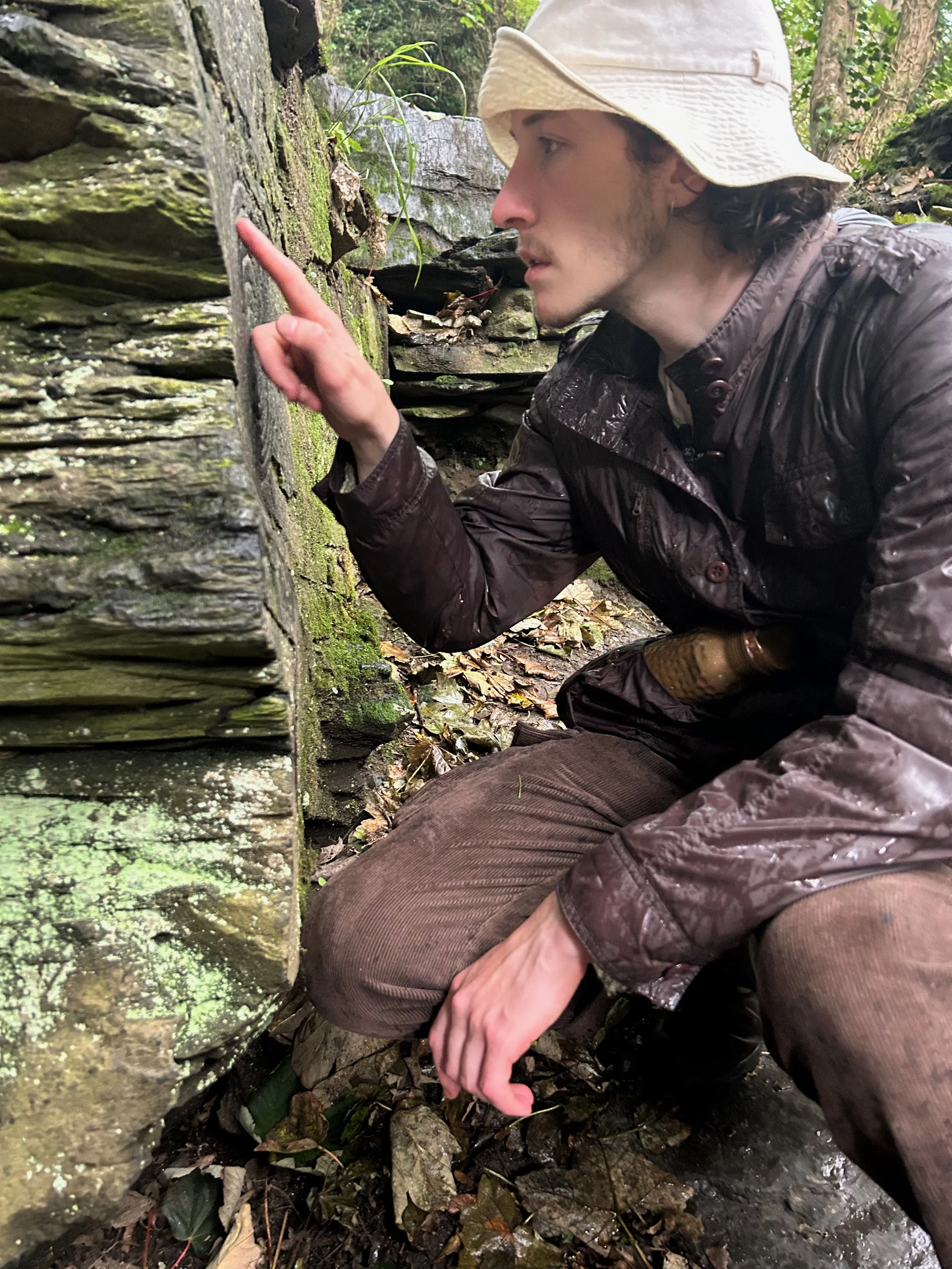
Layan traces a Rocky Valley carving…
There is also a theory that these symbols are linked with medieval pilgrimage and are early Christian in origin. This is due to their similarity to the Hollywood Stone in Ireland, which is believed to be the marker of an early Christian pilgrimage route, St. Kevin's Road. The labyrinth symbol is legitimately ancient, with its earliest use evident in the late Neolithic or Early Bronze age in rock carvings from the North of Spain (Jeff Saward has written a fantastic article about the earliest labyrinths) so the claim of Bronze Age origin is not totally out of the scope of possibility, but the symbol saw a revival in early Christian times when it was used as a representation of pilgrimage. This association has persisted throughout the ages, with labyrinth patterns found tiled into the floors of cathedrals, and even the C of E church on St Mary’s in the Isles of Scilly leading a pilgrimages to Troy Town Maze in 2025. Further up Rocky Valley is St Nectan's Glen, site of the hermitage of Saint Nectan, a 6th century saint who was said to “ring a silver bell in times of stormy weather.” The carvings have been attributed to a pilgrimage route sacred to Saint Nectan, in the same way that Troy Town Maze’s proximity to Santa Warna’s Well has sparked theories that this pebble labyrinth is also a symbol of pilgrimage to this saint. It is interesting to note that Saint Nectan was associated with storms, and Santa Warna could use the weather to cause or prevent shipwrecks, while Scandinavian labyrinths were used in weather magic, so the labyrinthine web of similarities and synchronicities continues to expand.
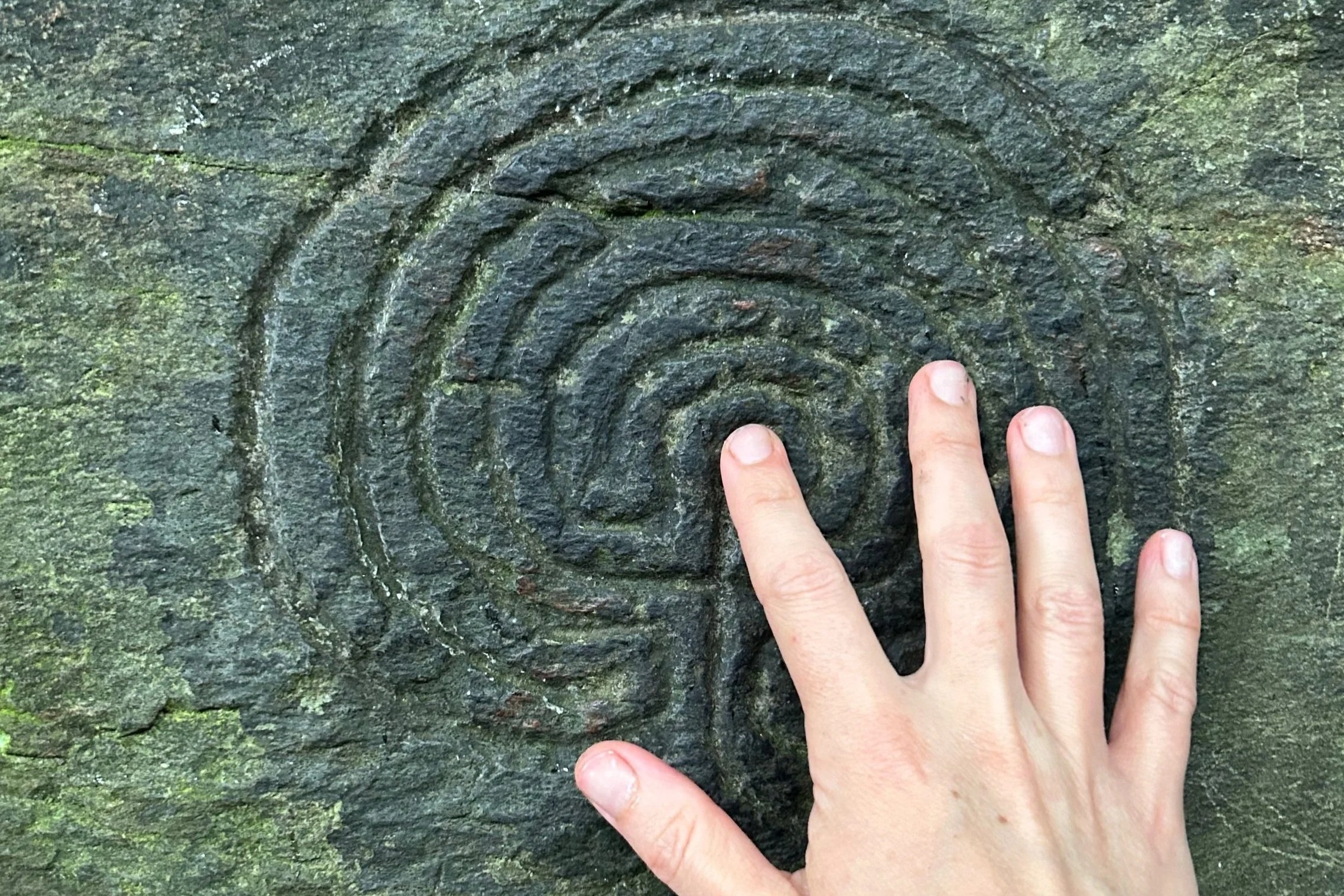
My fingers tracing one of the Rocky Valley carvings…
While we’ll likely never know the true origin of the Rocky Valley carvings of Troy Town Maze for certain, the enduring magic of the labyrinth symbol can be profoundly felt in encounters with these sites. Their meaningfulness - though undefinable - is palpably experienced by whoever encounters them - be they witchcraft cultist or christian pilgrim - in different and deeply personal ways.