The Snail Creep
“The Labyrinth was never a static object or a place. It was never a stone corridor. Instead, it was an event. It was a ritual dance to honour the bull and the annual rising of certain constellations. Each “passageway” was a chain of human hands, a serpentine gyration of gestures. The labyrinth was only ever the sacred relationship of people dancing - ecstatically, kinetically - inscribing the patterns of the sky into the soft dirt of the ground.”
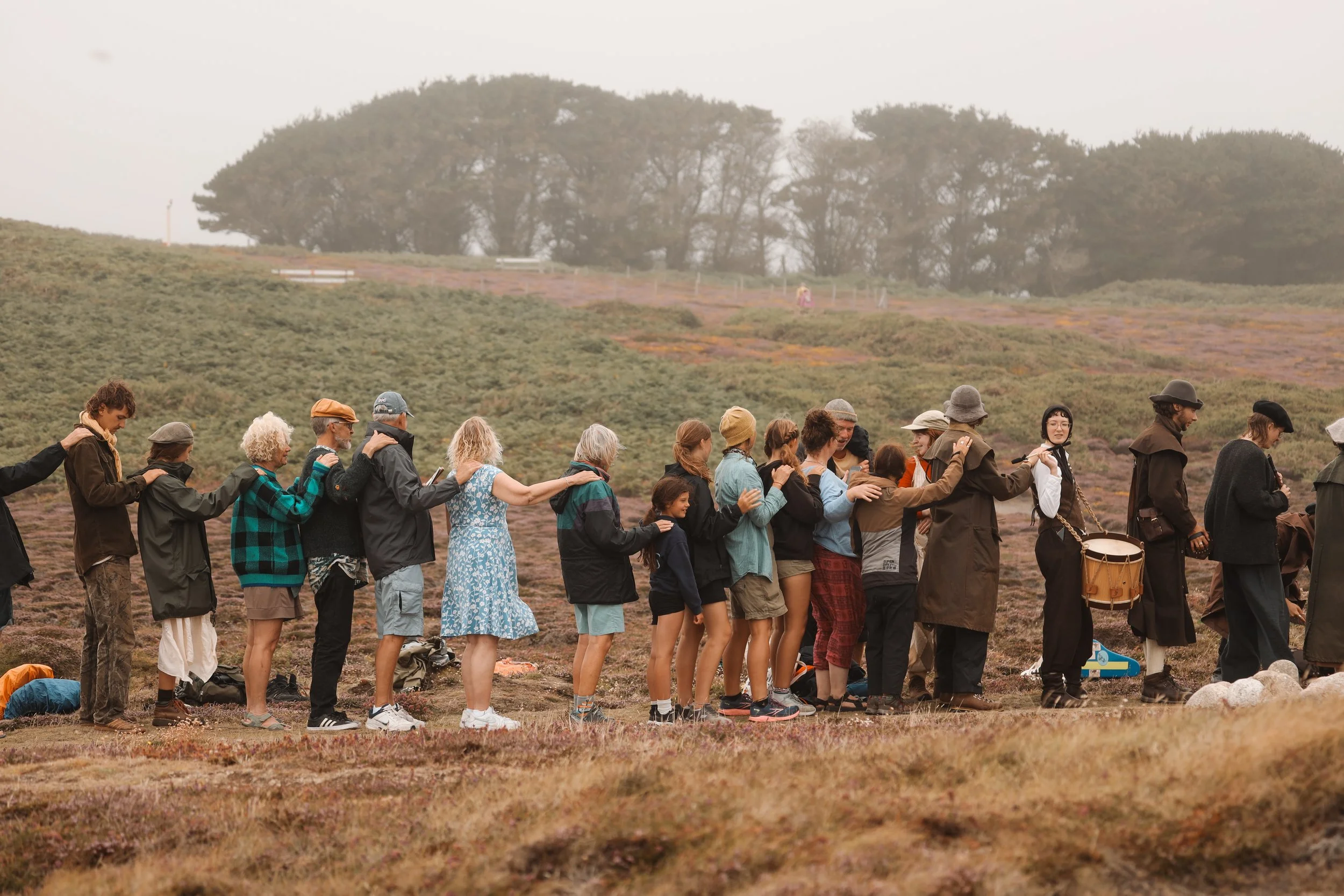
Participants at the Celebratory Reopening of Giant’s Castle Maze form up into a line to begin the Snail Creep dance…
Across cultures, labyrinths have long been associated with dancing, with fragments of texts from across antiquity linking the symbol with dance. These labyrinthine dances suggest long lines of people dancing in coils, engraving mazey shapes into physical space with their movements. Though no records of such dances survive in Scilly, nearby Cornwall is home to two coiling dances that are still practiced today - the Serpent Dance and the Snail Creep. These similar yet distinct dances are thought to have their origins in the medieval farandole, from Provence in France, which itself was believed by some to be directly descended from the Cretan Crane Dance that Theseus performed to celebrate his escape from the Minotaur’s Labyrinth.
“On his voyage from Crete, Theseus put in at Delos, and having sacrificed to the god and dedicated in his temple the image of Aphrodite which he had received from Ariadne, he danced with his youths a dance which they say is still performed by the Delians, being an imitation of the circling passages in the Labyrinth, and consisting of certain rhythmic involutions and evolutions. This kind of dance, as Dicaearchus tells us, is called by the Delians “The Crane” and Theseus danced it round the altar called Keraton, which is constructed of horns (“kerata”) taken entirely from the left side of the head. They say that he also instituted athletic contests in Delos, and that the custom was then begun by him of giving a palm to the victors.”
~ from Life of Theseus by Plutarch c.100AD, translated by Bernadotte Perrin
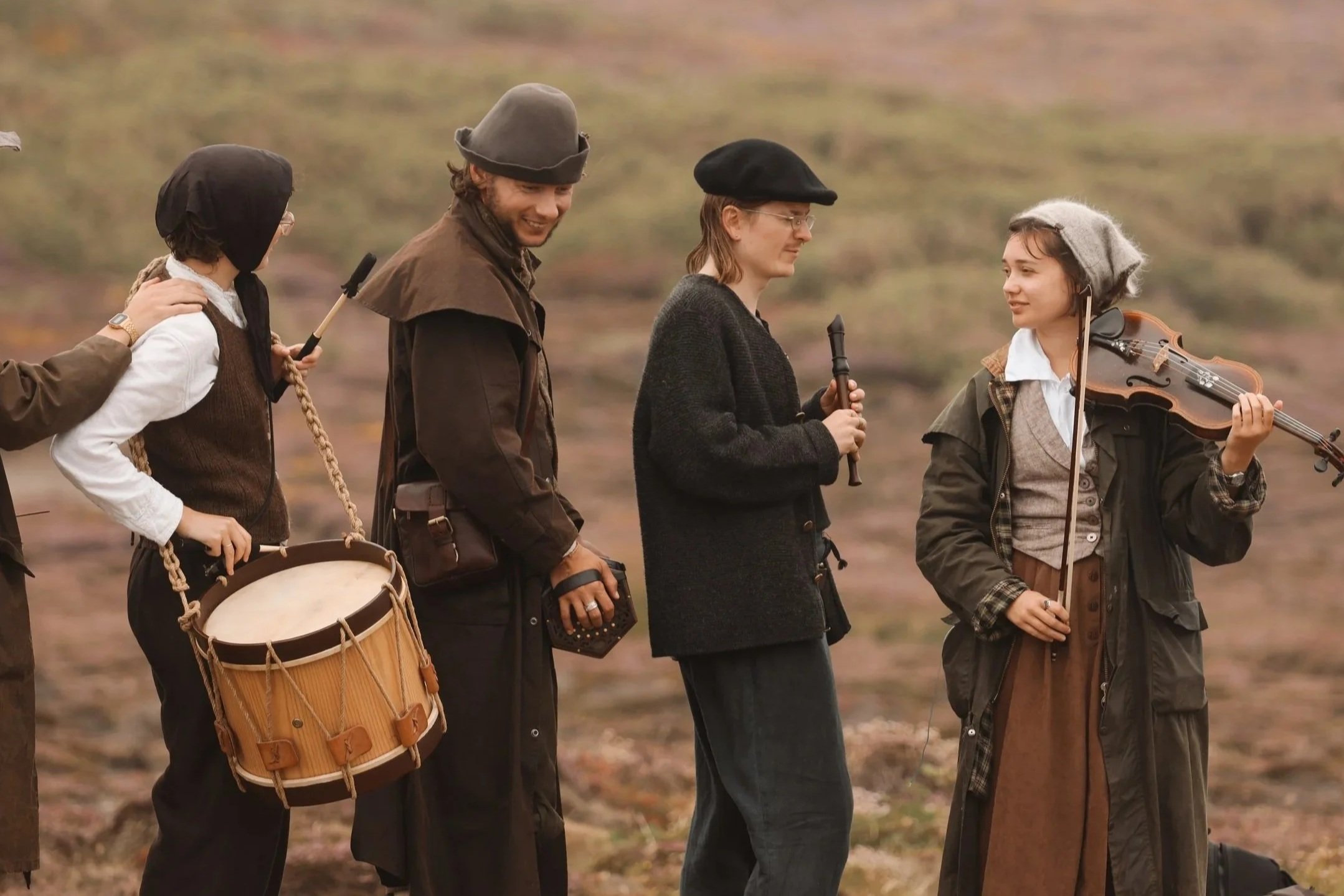
Goblin band prepare to lead the Snail Creep dance…
At our celebratory reopening of Giant’s Castle Maze we performed one of these traditional Cornish labyrinth-like dance - the Snail Creep - which originated from towns and villages in central Cornwall and was popularly danced during the Methodist “Tea Treat” dances from the 18th Century onwards.
“The villages of Rescorla, Molinnis, Roche, Trezaise, Inches, Withiel and St Wenn, along the eastern side of the Clay Country, marked their Tea Treats with a custom going under the name of the Snail Creep. The Snail Creep is a dance unique to this part of Cornwall, and involves a long procession of couples following a band, lead by two people holding up branches - the tentacles of the snail… There were no special steps, people just followed behind the band around the field and invited people standing watching to join in. As with the snake dances of other areas, it was 'the place for young men to pick their girls' and some married couples maintained that they originally met at the Snail Creep.”
~ from Scoot Dances, Troyls, Furrys and Tea Treats: The Cornish Dance Tradition by Merv, Alison and Jody Davery
It is an interesting synchronicity that the description of Theseus’s Crane Dance on the island of Delos mentions that the processional dance went around an alter “constructed of horns” and that Theseus was known for “giving a palm” branch to the winner of athletic contents. Comparably in 18th and 19th Century Cornwall, the Snail Creep was led by people carrying “leafy boughs looking like the home of a snail” - strange that these details would have reappeared to be mirrored in this dance, almost 2,000 miles and 3,000 years apart. I’m not trying to claim any kind of narrative historical causality here, only that this details feels like a furthering of the constellation of the labyrinth archetype - with minotaurs, bulls, snails, dances, horns, etc - which continue to spiral around this project, and the labyrinth-lore we are half-creating, half-remembering.
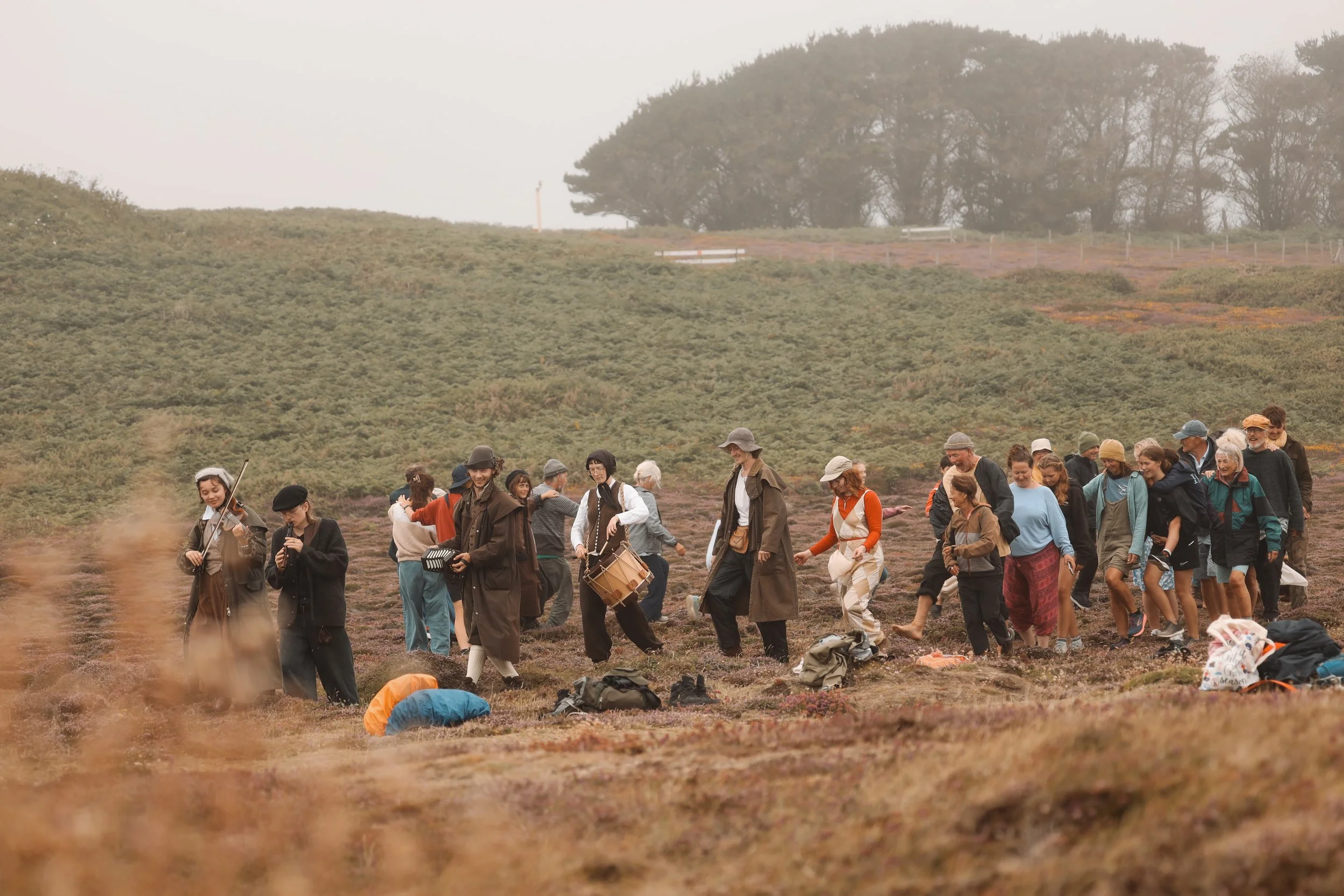
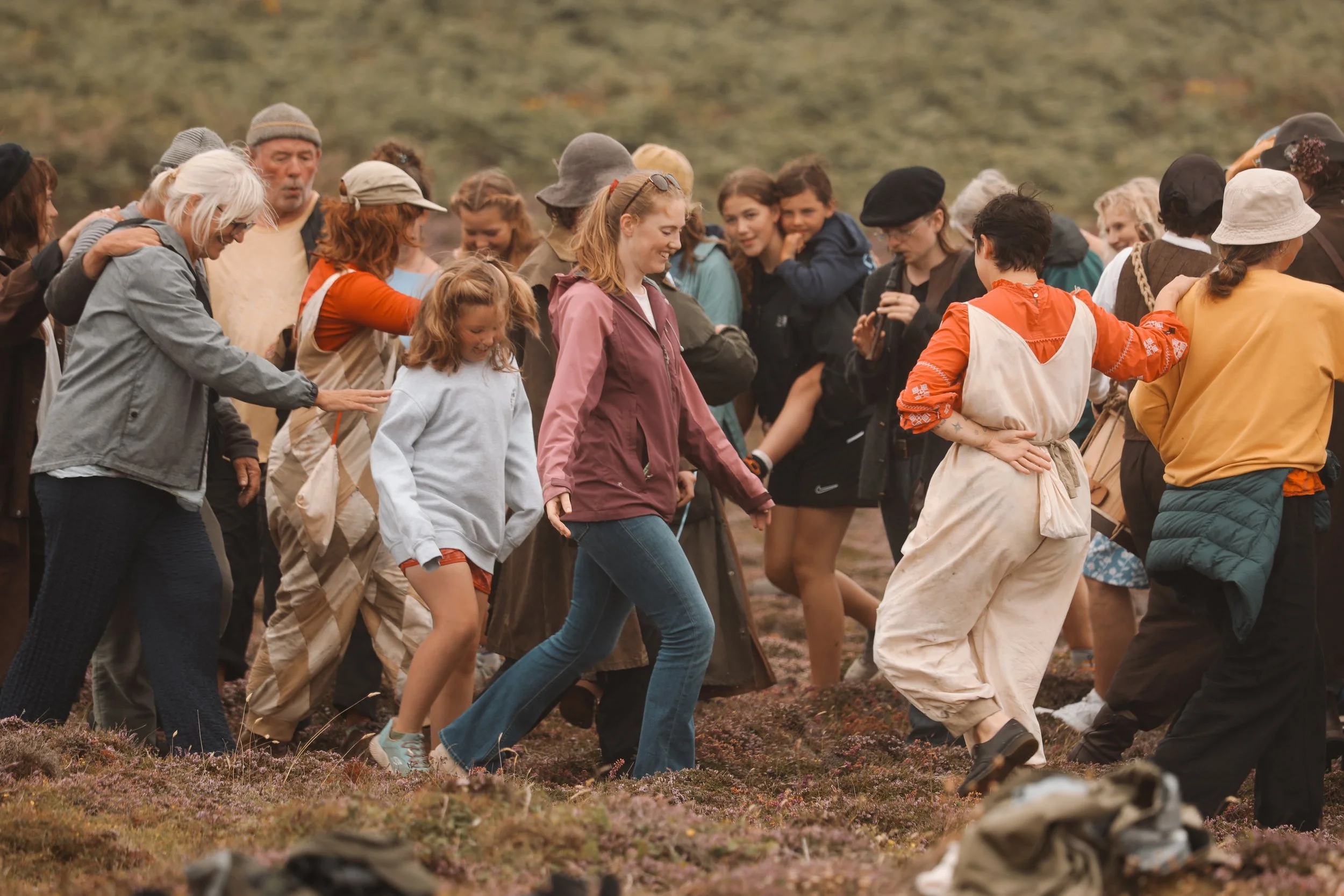
There were “no special steps” for the Snail Creep dance, which was lucky navigating the wavy heather on Salakee Down…
Our Snail Creep was led by violinist Alice Beadle of Goblin Band, who was followed by the other members of the band playing the (very catchy) Snail Creep song. They in turn were followed by all who wanted to join in the dancing. We did not follow the formula of the traditional Tea Treat Snail Creep exactly - by splitting into couples and dancing with snail-horn tree branches (there are not many trees on Salakee Down) - but instead we let our own version of the dance evolve organically. The Scillonian Snail Creep we inadvertently created was more similar to the Snake Dance practiced widely in nearby Penzance: a long coil of winding people joined by hands and shoulders.
“The dance is led by two people, traditionally with leafy boughs looking like the home of a snail, followed by the band and then the dancers. They process in a spiral and tum about at the centre and back on themselves in a counter movement, the dancers appearing to move in opposite directions.”
~ from Scoot Dances, Troyls, Furrys and Tea Treats: The Cornish Dance Tradition by Merv, Alison and Jody Davery
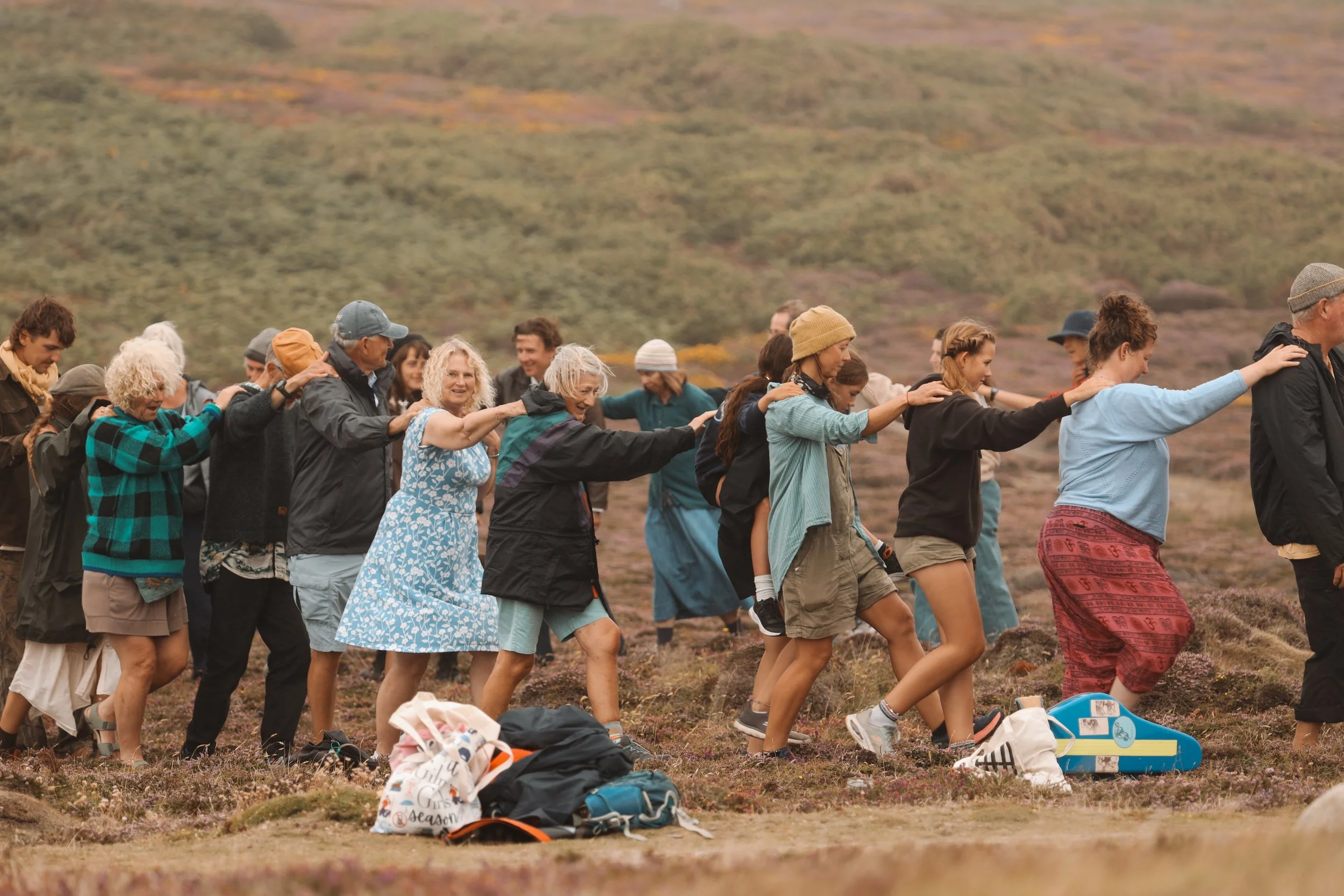
Dancers of all ages joined in the Snail Creep…
In the time of Theseus, the Crane Dancers would have had to trust that the shapes they were dancing into the ground were mimicking the labyrinth’s coils, as these are difficult to discern from ground-level. But today, with the help of technology, we can get crane’s-eye-view of the dance, where the similarities are undeniable. These areal drone shots - captured by the wonderful Inga Drazniece - show the coiling Snail Creep dancers next to the restored Giant’s Castle Maze. Seeing these two winding forms side by side, it is easy to see why there are so many connections between labyrinths and these kinds of dances.
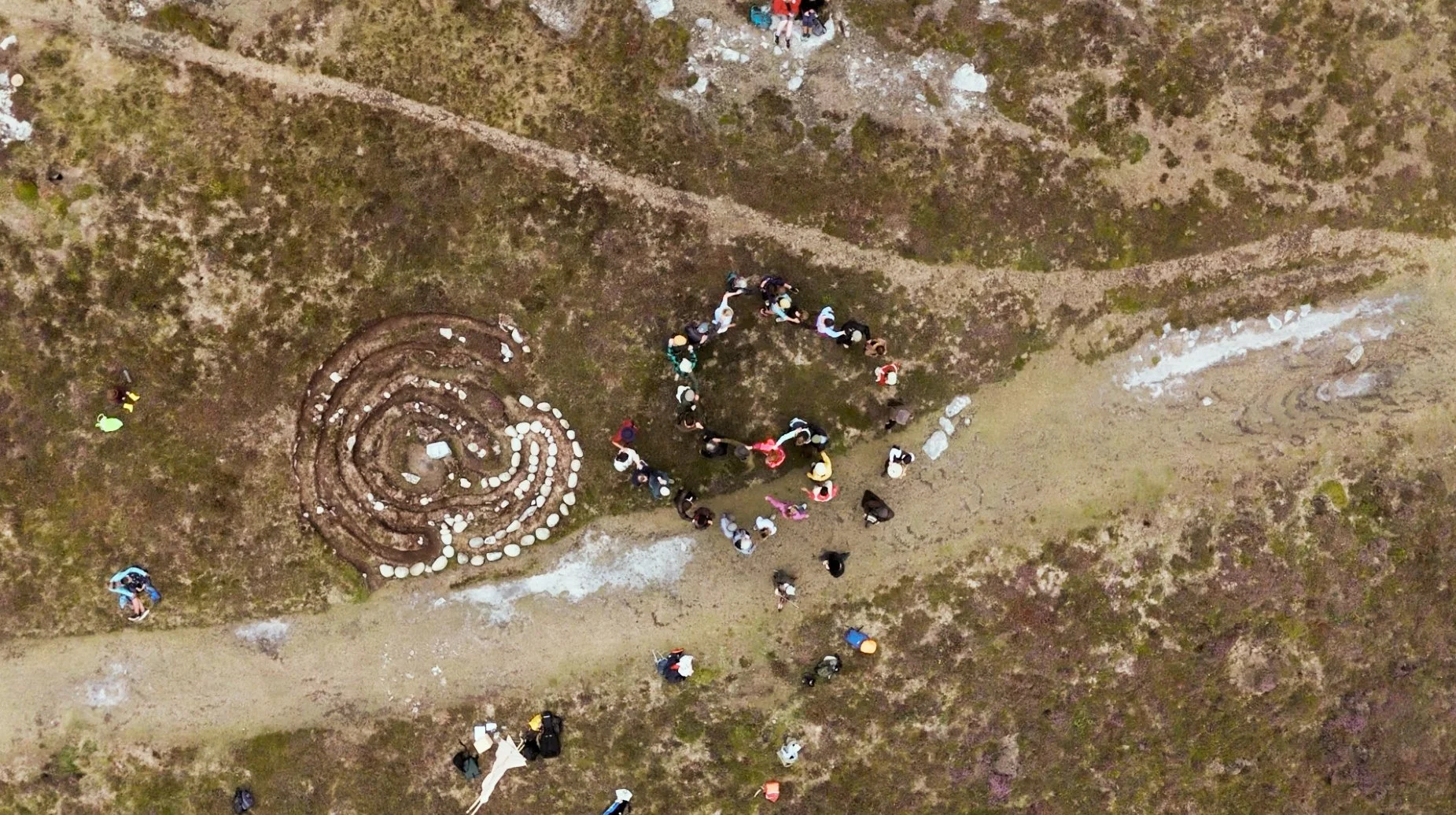
The dancing coil turns in and out, beside the newly restored maze.
“In Mercurial fashion, the movement through the labyrinth veers back and forth, round and round, creating a dance whose steps eventually weave a vessel strong enough to hold what was at first intolerable experience. A transcendent pattern eventually emerges, which lifts one to a new vantage point.”
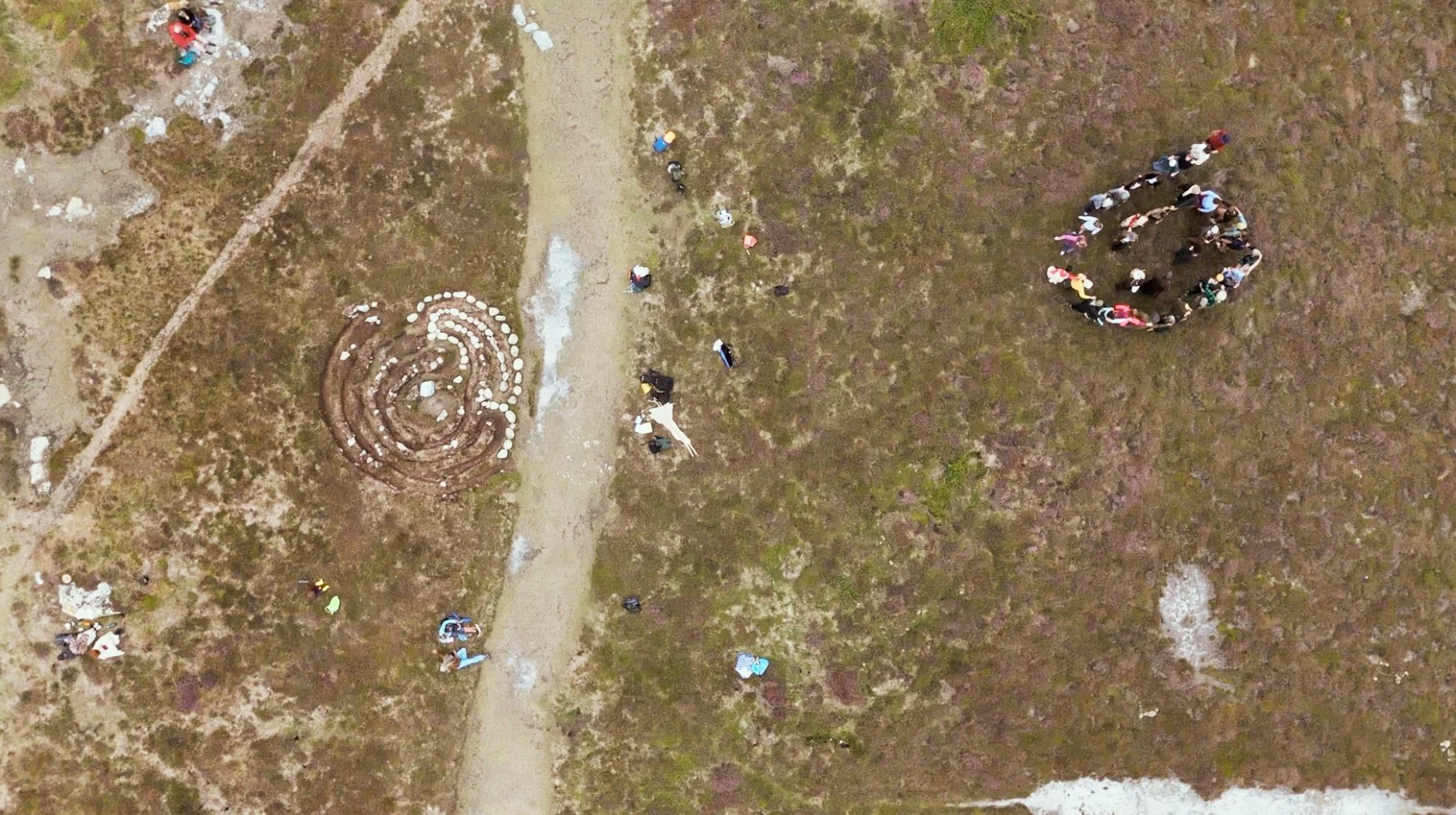
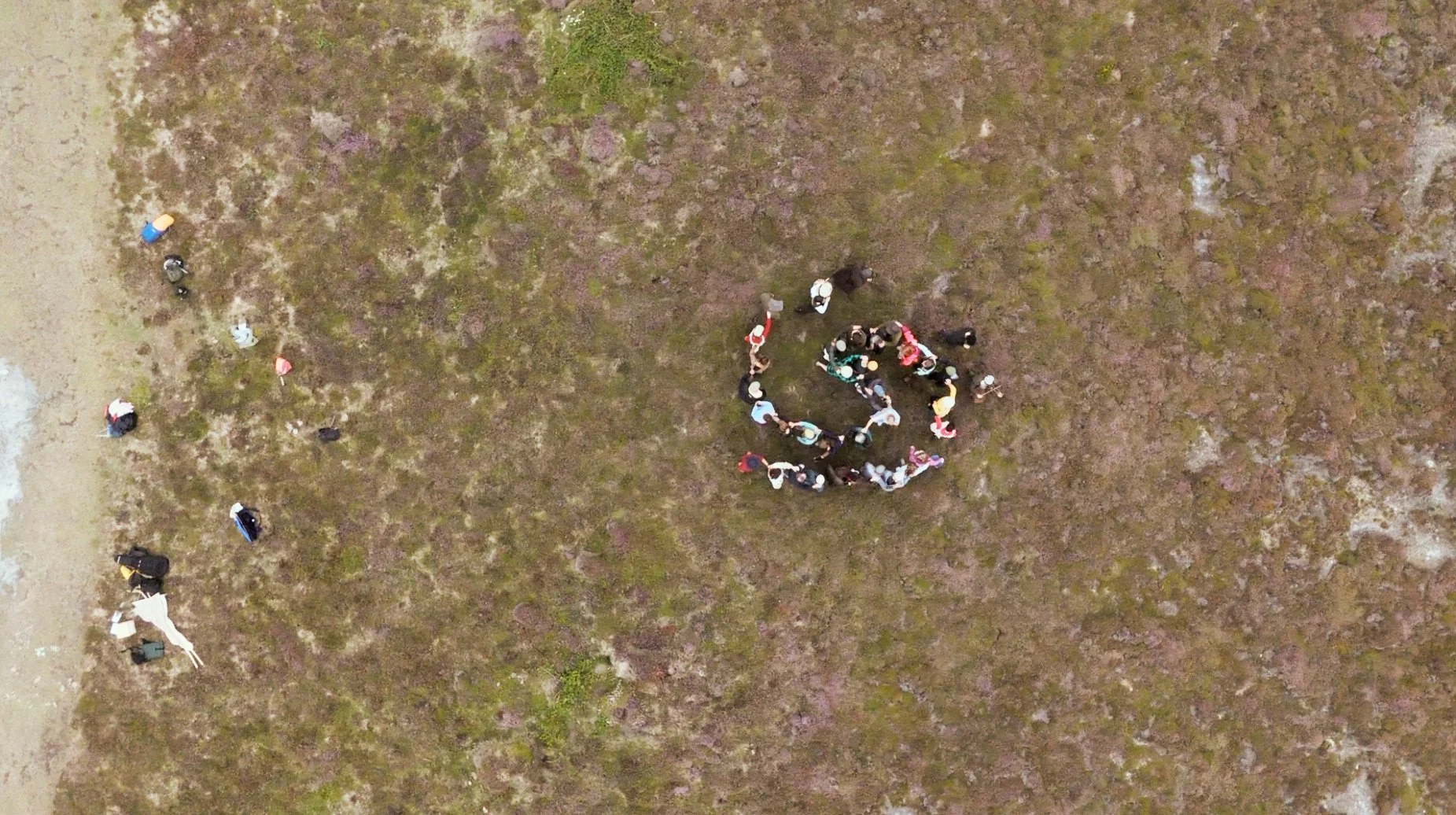
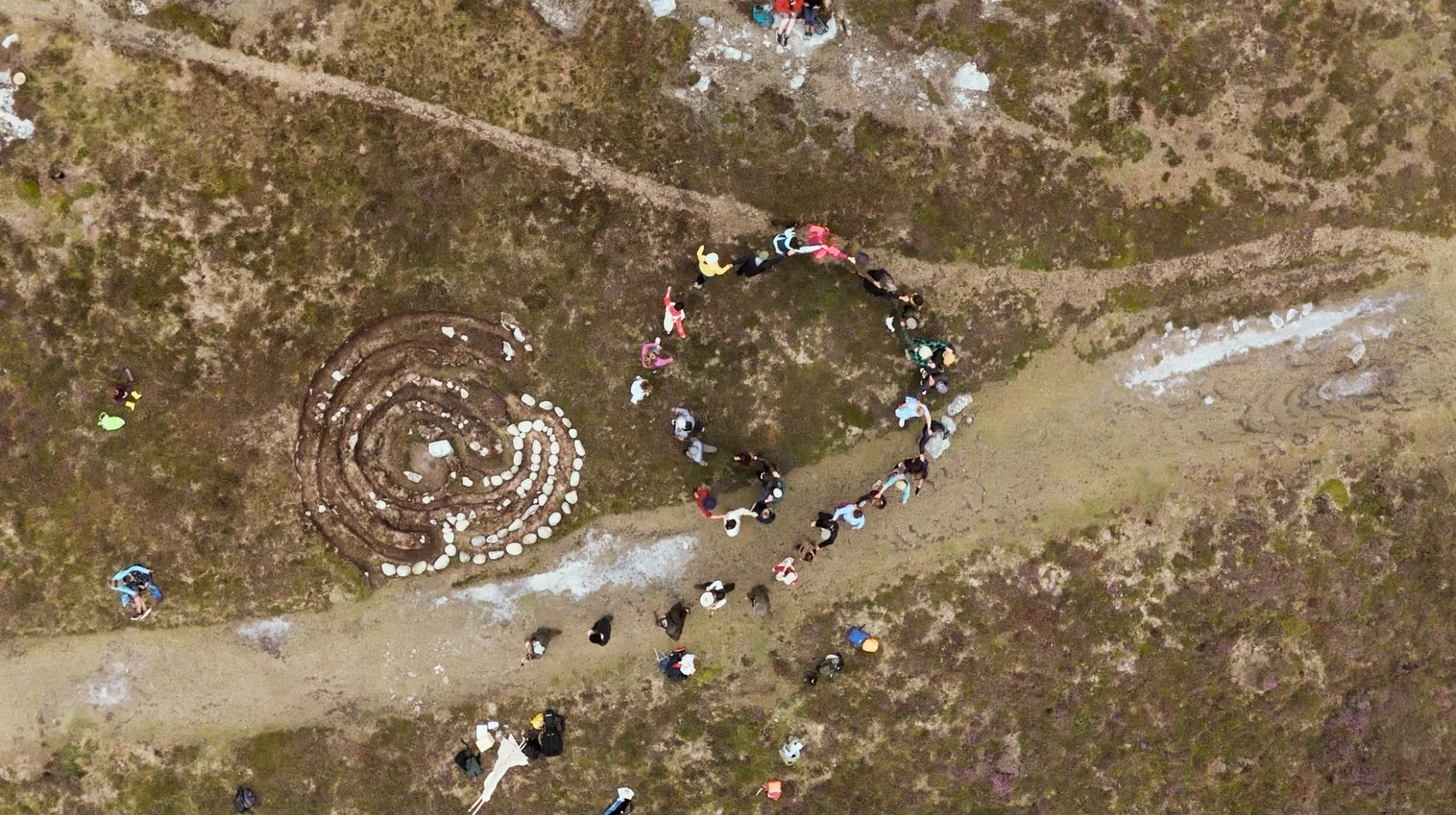
When we were thinking about the best approach to restore Giant’s Castle Maze, we made the decision not to try to take it back to the original design from the 1950s by a full archaeological investigation and rebuild, but instead to continue the existing paths to reform the derelict maze to a usable, unicursal labyrinth again. After our test excavations of the site, we came to the conclusion that Giant’s Castle Maze had been made collaboratively - a collaboration between the land; the two teenagers who first laid the stones in 1952; and the generations of feet that had walked the paths ever since, changing the shape organically over time. Perhaps it is this organic labyrinth pattern which makes our maze look so similar to the shapes created by the dancing snail creep, as the current iteration of Giant’s Castle Maze really has been created from people’s movements, inscribing their shape onto the ground, rather than following a traditional labyrinth design.
Although the Snail Creep is most strongly associated with 18th Century Methodist Tea Treats, it is thought that these (respectable and sensible) events were preserving older Cornish dance culture, and that the Snail Creep actually has far more ancient origins. This shared parallels with the Scillonian May Day Festival, which was a Victorian Christianised revival of far older but lapsed May rites practiced on the islands. By re-packaging these older “pagan” practices (which, given Scilly’s location, probably originated in Beltane celebrations) for a respectable, Christian audience of the day, the old customs were (admittedly imperfectly) preserved.
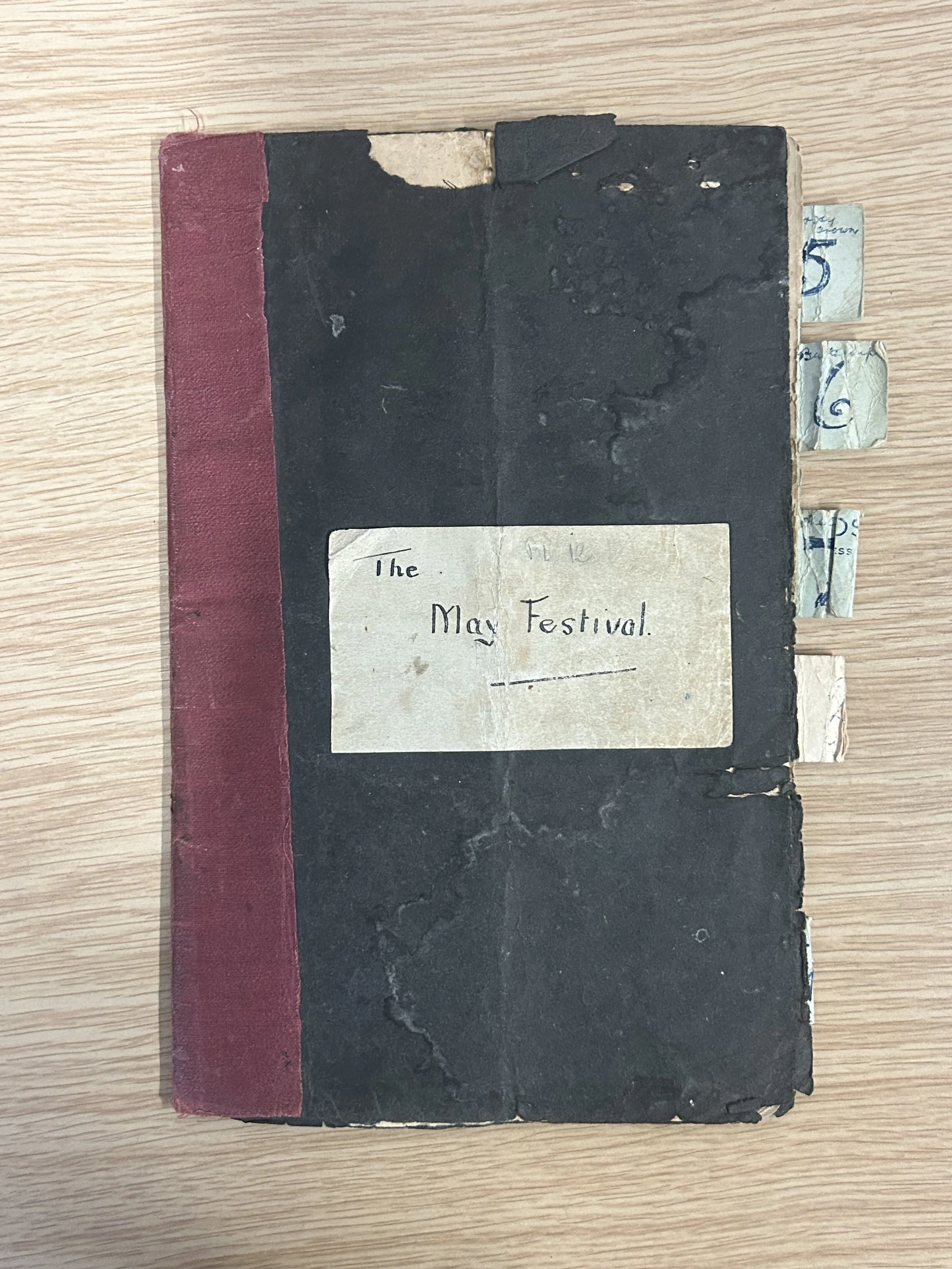
Scilly’s 150 year-old May Day pageant began in this book…
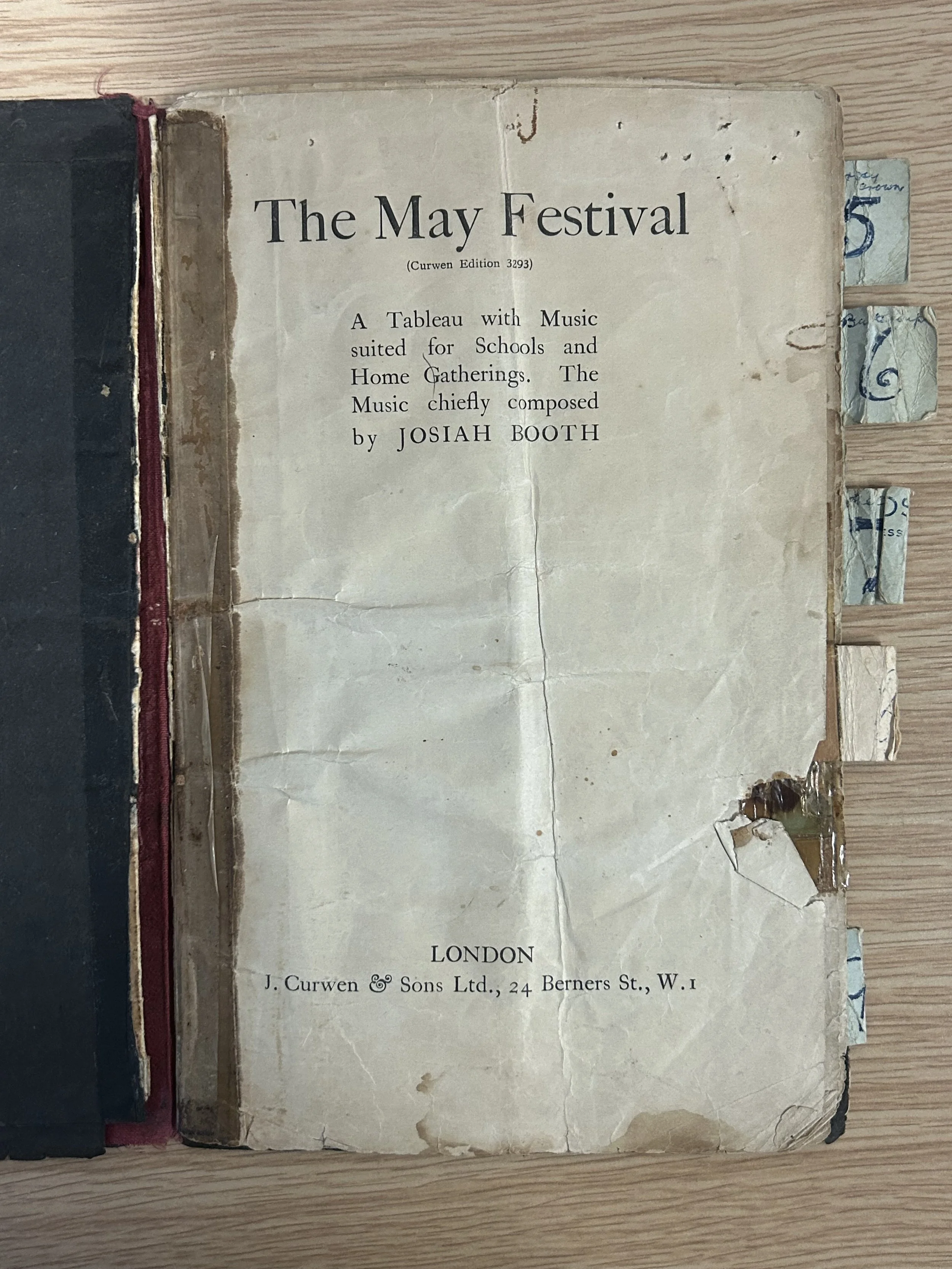
“The May Festival: A Musical Tableau”
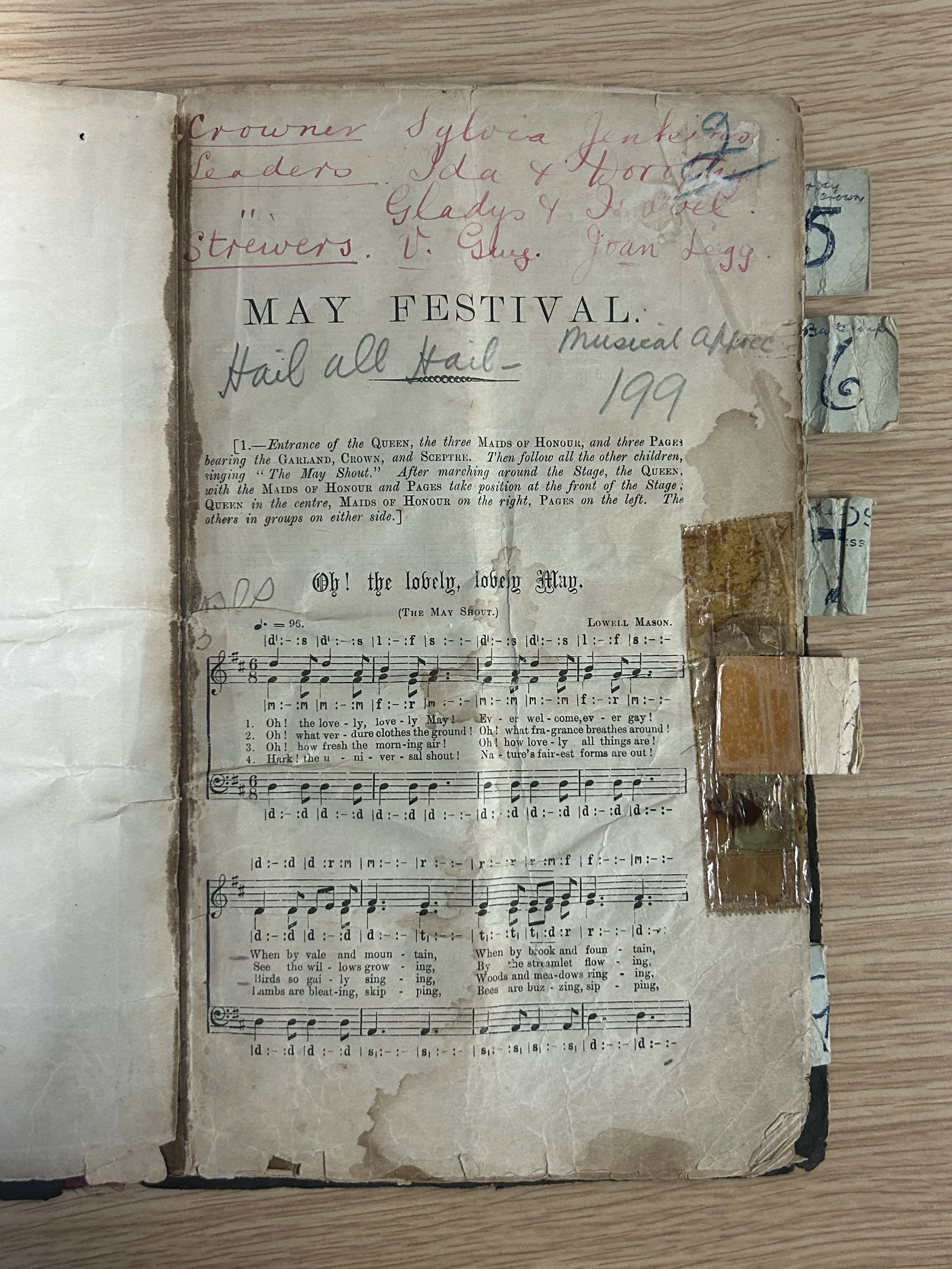
…by hymn-composer Josiah Booth (1852-1929).
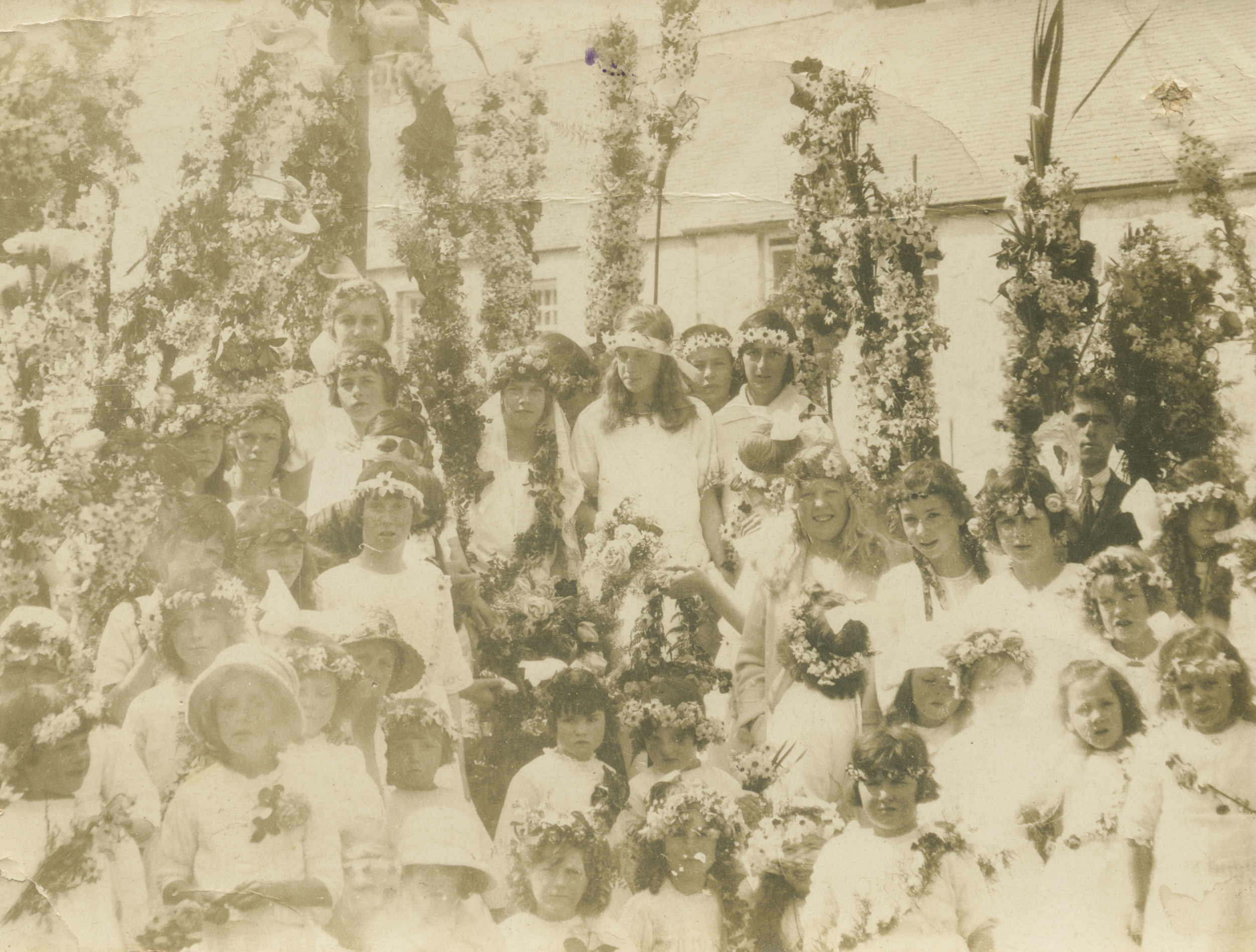
St Mary’s May Day, 1924 - the pageant has remained virtually unchanged for 150 years.

St Mary’s May Day, 1996 (including very tiny me - far right, middle row).
“At Roche and in one or two adjacent Parishes a curious dance is performed at their annual feasts and which, I am of the opinion, is of very ancient origin. It enjoys the rather undignified name of 'Snail Creep' but would more properly be called the serpent's coil. The following is scarcely a perfect description of it: The young people being all assembled in a large meadow, the village band strikes up a simple but lively air and marches forward followed by the whole assemblage, leading hand in hand (or more closely linked in the case of engaged couples) the whole keeping time to a lively step. The band or head of the serpent keep marching in an ever narrowing circle whilst its train of dancing followers becomes coiled precision. The lively music and constant repassing couples make this a very exhilarating dance and no rural sports which our poets treat could be more thoroughly enjoyable.”
~ from The Western Antiquary of 1881
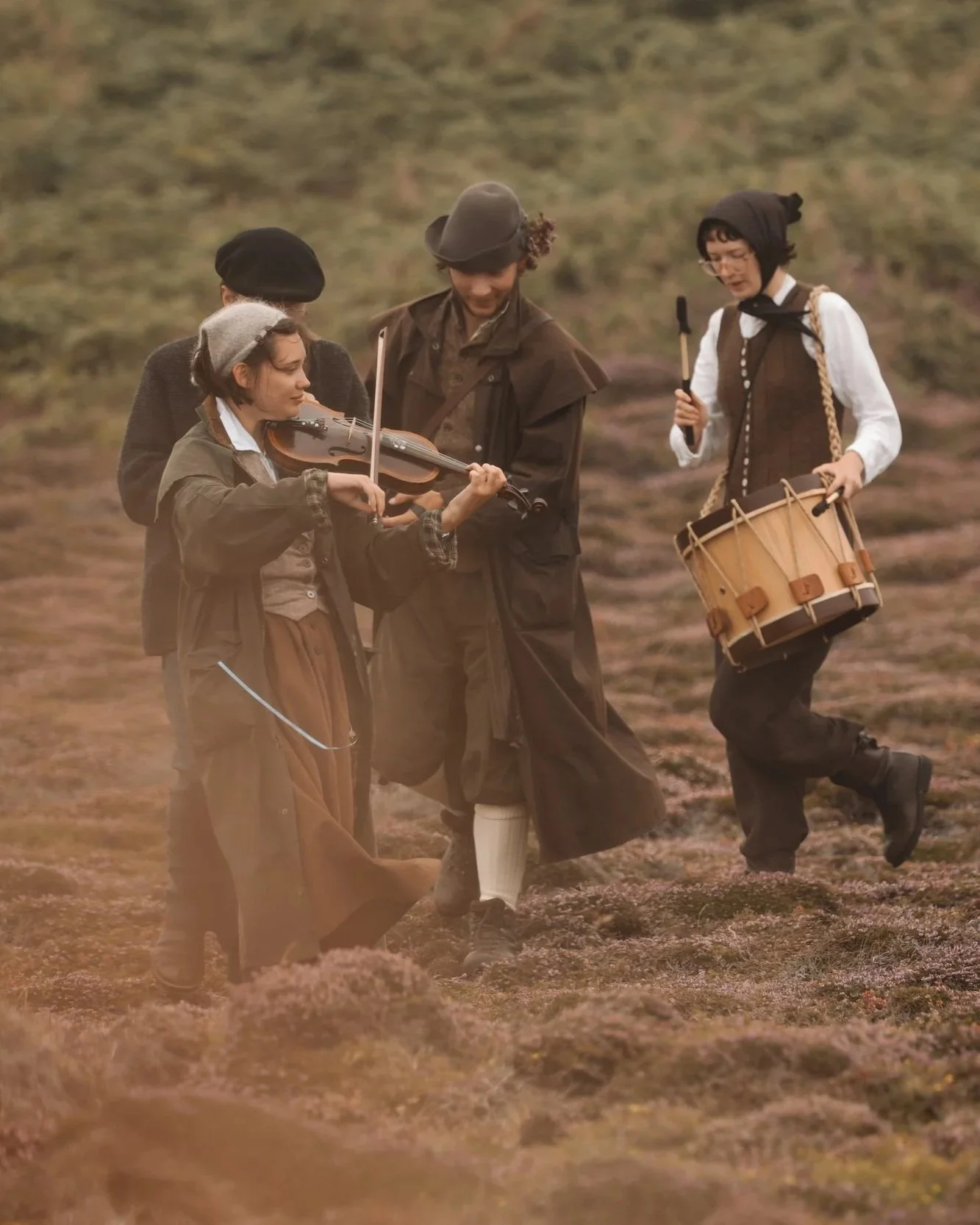
Goblin Band leading the Snail Creep...
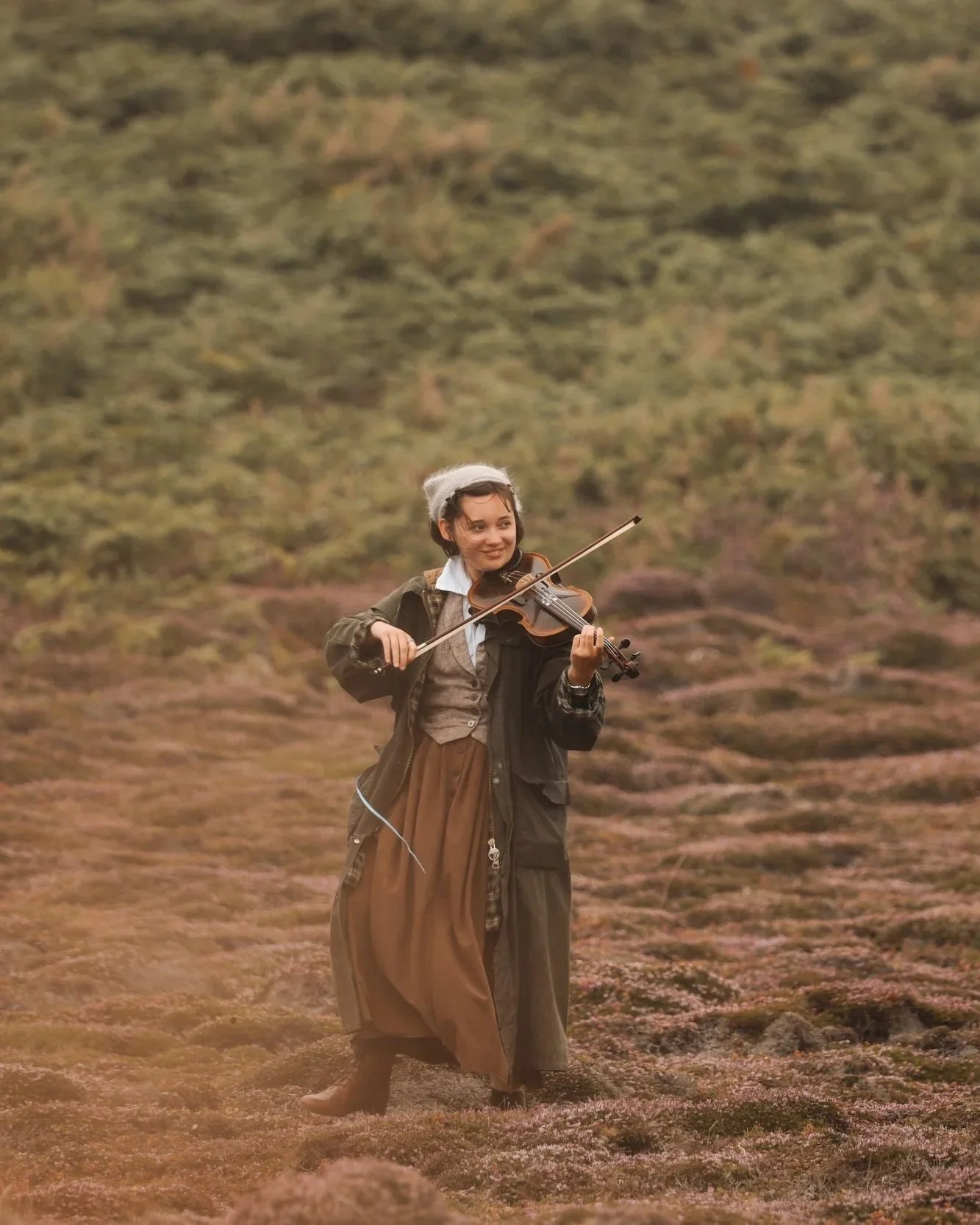
Alice Beadle bringing a mischievous atmosphere to the dance…
Alice was the perfect person to lead our Snail Creep as she has experience calling dances at Cèilidhs/Céilís. These Scottish/Irish dances, together with the Cornish Nos Lowen and the Breton Fest Noz, are an enduring feature of Celtic peoples, and link current Celtic communities to their pasts. Scilly would likely have been an important centre of Celtic culture, positioned at a key point between Brittany and Ireland, Cornwall and Wales, at a time when much travel and trade was done by sea. While it is impossible to know what kind of dances these people may have practiced on Scilly, if at all, it is fun to imagine the ancient roots of our dance, winding back through the different eras of Tea Treats and Saint’s Days, and eventually connecting us to the same people who built the Iron Age Cliff Fort of Giant’s Castle, which stands beside the labyrinth on Salakee Down.
“It is the Tea Treat tradition promoted by, but not exclusive to, [Methodist] chapel culture that has provided a rich vein of music and dance tradition in Cornwall. This is a custom that evolved out of the village feast day towards the latter part of the 19th century, and has survived well into living memory, and arguably continues to survive in the form of various village celebrations and fêtes today… These Tea Treats also acted as a conduit for folk customs that were much older in origin, such as the serpent dances and circle dances, as well as step dances and broom dances.”
~ from Scoot Dances, Troyls, Furrys and Tea Treats: The Cornish Dance Tradition by Merv, Alison and Jody Davery
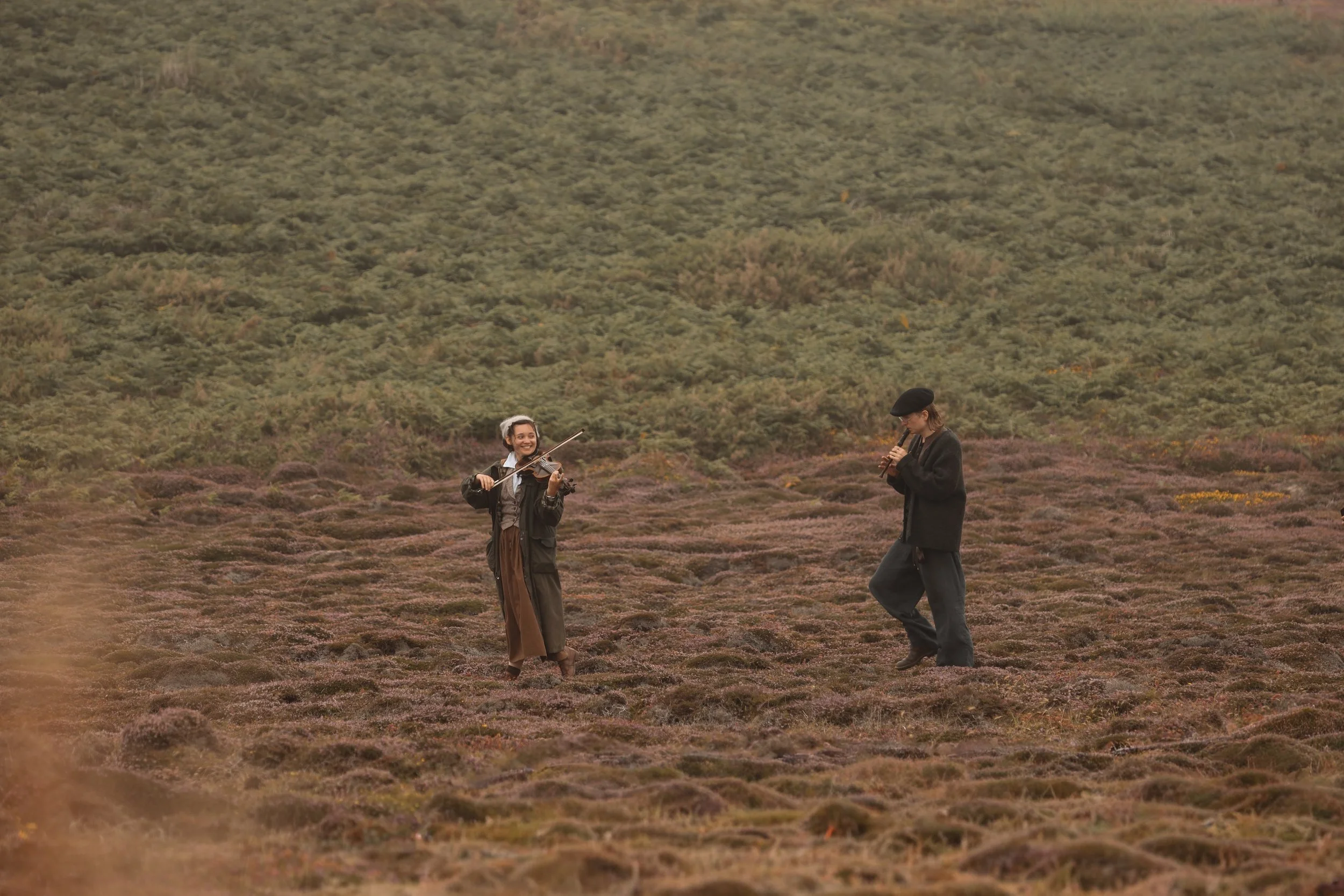
The flat expanse of ground on Salakee Down, under the castle and adjacent to two stone circles, may have been a dance-floor for the Iron Age people of Scilly...
Mention has been made of the Snail Creep dance playing a part in pagan revival witch-craft rites in nearby Cornwall, where this (probably ancient) dance that was repackaged for wholesome Methodist dances, was again repurposed for magical practices. This continual process of adaption of this classic dance to suit the needs of the people of the day, reflects the enduring symbol of the labyrinths, which has been similarly adopted and claimed by Christianity (even in the case of St Agnes’s Troy Town Maze, which does not follow the medieval Christianised labyrinth pattern at all) and as a magical symbol connected with witchcraft and magic (like the Troy Stones in the Museum of Witchcraft and Magic and the carved labyrinths at Rocky Valley).
“The Nemeton rituals were influenced by The Regency, and what I picked up myself relating to Cornish folklore. For example I was interested in the spiral 'Snail Creep' dance, and I introduced the Cornish names of the feasts.”
~ The Re-enchanted Landscape: Earth Mysteries, Paganism & Art in Cornwall 1950-2000, by Rupert White
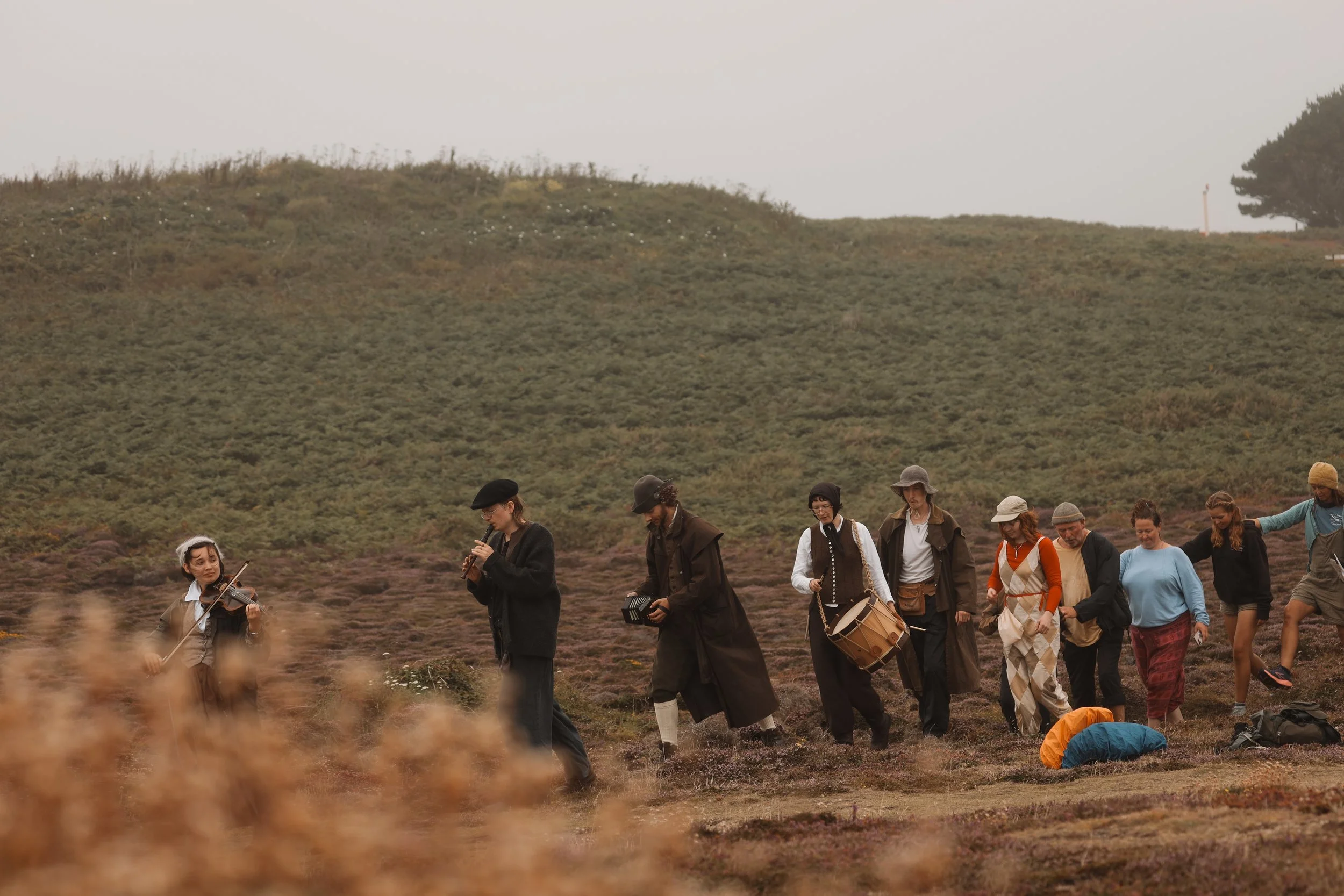
The Snail Creep’s windings continue across the ritual landscape.
As mentioned in our previous blog post about The Bullhorn and The Biggal Fool, snails play an important role in Cornish folklore. They were considered to be a symbol of good fortune by Cornish miners, the same communities who were attending the Methodist Tea Treats and dancing the Snail Creep in the 18th and 19th Centuries.
“The obvious reason for calling this dance the 'Snail Creep' is the way in which it coils in on its self like the markings on a snail shell, and also the way in which people leading it held branches aloft like the snails tentacles. Whether there is any deeper mythology behind this we do not know although according to Morton Nance snails were held in certain esteem by miners, who offered a snail a drop of melted tallow from their candles or a crumb of pasty or fuggan on seeing one on their way to bal (mine) in the morning. There are also children's rhymes found elsewhere in Cornwall associated with snails.”
~ from Scoot Dances, Troyls, Furrys and Tea Treats: The Cornish Dance Tradition by Merv, Alison and Jody Davery
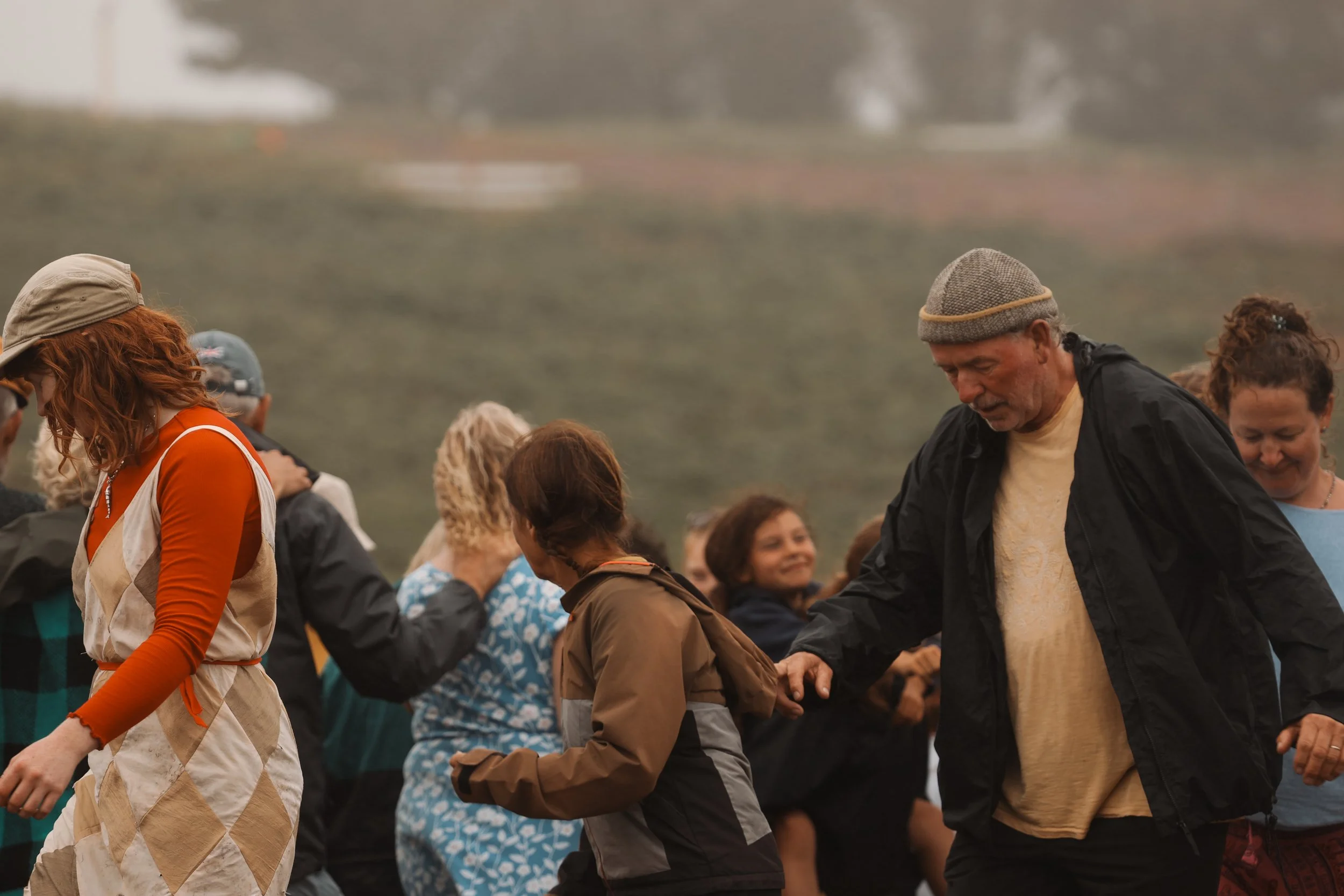
Sky Turner in costume as The Biggal Fool joining in the Snail Creep with the event attendees…
“The shells of snails are favoured also, not only for their protective shell, but for their traditional associations in the West Country with power - sexual force, fertility, fecundity and creation. Also here are the creatures credited with the ability to bestow blessings upon places and people, thus are their shells gathered to fashion charms to bring protection, potency, passion and good fortune upon the home and life endeavours of their keeper.”
- Gemma Gary, The Black Toad: West Country Witchcraft and Magic, (2012)
The symbolic meaning of the snail as an image of fertility and sensuality in Cornish folk tradition may also have endured in the Snail Creep dances practiced by mining communities at Methodist dance events. These Tea Treat dances, despite their air of chaste respectability, were still opportunities for young people of all genders to come together.
“During my boyhood, feast days were great events. These were well arranged so as not to take place on the same day - this enabled people to travel from one village to another. It was the one great event of the year, sometimes there would be a competition between various places in matter of teas games and other amusements. Weather permitting tables would be lavishly spread in the open air consisting of splits and cream, home baked bread and saffron cakes. In the fading light the fife and drum band could be heard in the distance. Presently it would march on to the field and this was the summons for all young people to choose a member of the opposite sex. Then linking arms the stage was set for the 'Creep' ”
~ from The Cornish Magazine of 1958
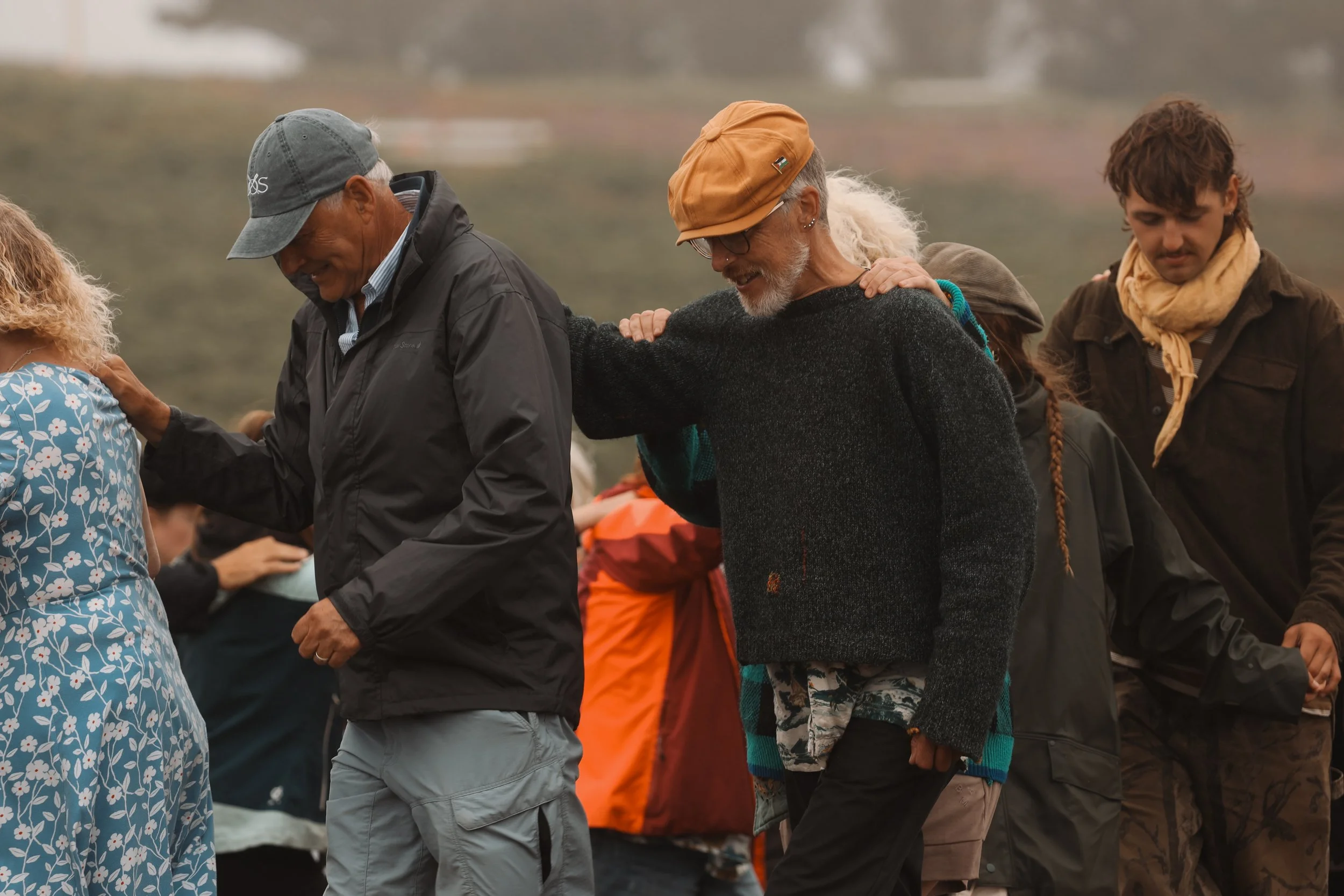
Locals and visitors to the Isles of Scilly of all ages joined in the eternally fun, ancient and universal experience of joining together in dance…
Dancing the Snail Creep dance together brought so much joy to this labyrinth event, and was many people’s favourite part of the day. Doing this deep-dive into this dance’s history and meaning has further highlighted the importance of coming together in the landscape and connecting - bodily thorough movement and participation - with the folklore and traditions of our past. This kind of spiralling dance connection has existed in almost identical iterations throughout the world for the whole span of human history, and - we feel - it is something that should be continued long into the future too.